
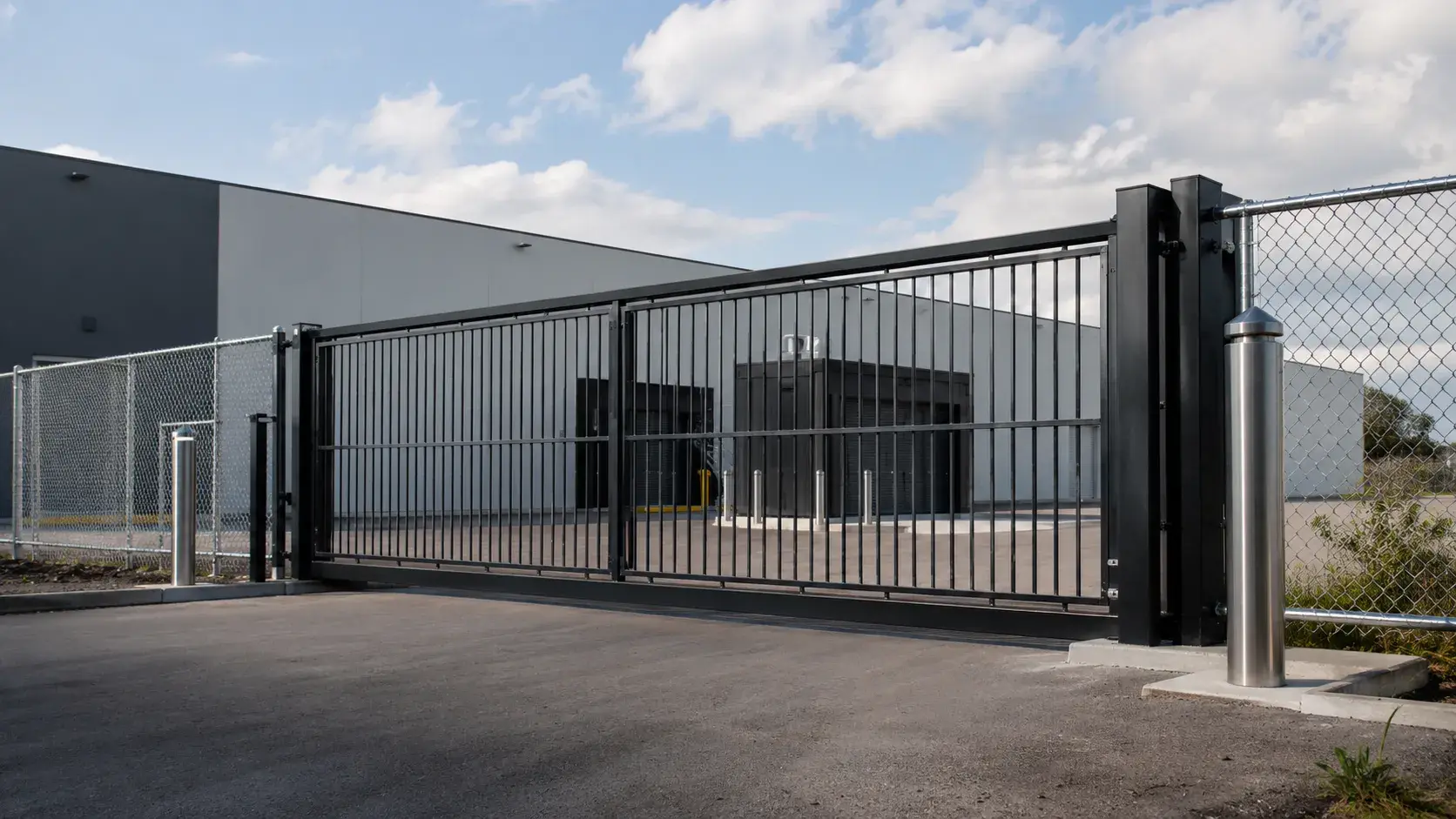
Custom Metal Gates: Swing, Slide, and Cantilever Explained
A guide to custom metal gates: swing, slide, and cantilever types, materials and finishes, sizing and clearances, and how to choose a gate for security, access, or vehicles.
Custom metal gates fall into three main types: swing gates that pivot on hinges, slide gates that roll sideways on a track, and cantilever gates that span an opening without touching the ground. The right choice comes down to how much room you have to either side of the opening, the slope and surface of the site, and whether you are controlling people, vehicles, or both. Swing gates suit tight budgets and level sites with clearance to open, slide gates suit wider vehicle openings with straight fence runs beside them, and cantilever gates suit dirty, sloped, or snow prone sites where a ground track would jam.
At The Grate Guys, we fabricate custom metal gates and architectural metalwork for contractors, facility managers, municipalities, and industrial clients across the GTA and Ontario. We are licensed, insured, and WSIB covered. This guide walks through each gate type, manual versus automated operation, the materials and finishes we work with, sizing and clearances, and the site factors that decide which gate is right for your opening.
Swing Gates
A swing gate pivots on hinges mounted to a post or wall, exactly like a door. It is the simplest and usually the least expensive gate to build and install. Swing gates work well for pedestrian openings, single or double vehicle driveways, and any spot where you have clear space for the leaf to swing through its arc.
The main limitation is that arc. A single swing leaf needs an unobstructed path equal to its width, and a wide opening either needs a very long leaf (which stresses hinges and posts) or a double gate with two leaves meeting in the middle. Swing gates also do not suit sloped driveways well, because a leaf that clears the ground when closed can bind against a rising grade as it opens.
- Best for: pedestrian access, narrower driveways, level ground, lower budgets.
- Watch for: swing clearance, wind load on solid infill panels, and hinge and post sizing on wide leaves.
Slide Gates
A slide gate (also called a rolling gate) moves sideways to open instead of swinging. A traditional V track slide gate rolls on wheels that run in or on a steel track set into the ground, guided by rollers at the top. Because it slides parallel to the fence, it needs no swing clearance in front of the opening, which makes it a strong choice for wide vehicle gates and for sites where a car might sit close to the gate.
The trade off is the track. A slide gate needs a clear, straight run of space beside the opening at least as long as the gate itself for the leaf to retract into, and the ground track has to stay clear of gravel, ice, snow, and debris to roll smoothly. On dirty industrial yards or in Ontario winters, a ground tracked slide gate can demand real maintenance.
Cantilever Gates
A cantilever gate is a slide gate with no ground track. The gate leaf is counterbalanced and carried on rollers mounted to posts on one side, so the leaf floats across the opening with nothing touching the ground below it. This is why cantilever gates dominate on sloped, muddy, snowy, or heavily trafficked sites: there is no track to jam, freeze, or fill with debris.
The cost is space and material. A cantilever gate needs a counterbalance section (the tail) that extends past the opening, often a large fraction of the opening width, along a straight fence run. That means more steel and more room to one side than a comparable slide or swing gate. For a wide commercial or industrial entrance that has to work in every season, the extra material is usually worth it.
Gate Type Comparison
| Gate type | Space needed | Best use |
|---|---|---|
| Swing | Clear arc in front of the opening equal to leaf width | Pedestrian gates, narrower driveways, level sites, lower budgets |
| Slide (V track) | Straight run beside the opening at least as long as the gate, plus a clear ground track | Wide vehicle gates where a car may sit close to the gate and the ground stays clean |
| Cantilever | Straight run beside the opening for the leaf plus a counterbalance tail, no ground track | Sloped, muddy, snowy, or high traffic industrial and commercial entrances |
Manual vs Automated Operators
Any of these gate types can be operated by hand or driven by an automatic operator. Manual gates are simpler, cheaper, and have nothing to power or fail, which suits low traffic openings and pedestrian gates. Automated gates add convenience, access control, and throughput for busy vehicle entrances, but they also add cost, wiring, and a set of safety requirements that must be taken seriously.
Operators are matched to the gate type: swing operators (arm or hinge mounted), slide operators that drive a chain or rack, and cantilever operators sized to the leaf weight and length. Whatever the type, the operator, safety devices, and controls should be specified and installed correctly by a qualified installer. Automatic gates are powered machines that move heavy steel, and photo eyes, safety edges, and proper force settings are what keep them from injuring people or vehicles. We fabricate gates that are ready for automation and coordinate with your operator supplier or installer so the mechanical package and the drive are matched.
- Manual: lower cost, no power needed, ideal for pedestrian and low traffic gates.
- Automated: access control, intercoms, loop detectors, and keypads for busy vehicle entrances, with safety devices that must be correctly specified and installed.
Materials and Finishes
Gate material is a balance of strength, weight, corrosion resistance, and cost. The heavier the leaf, the more it stresses hinges, rollers, posts, and operators, so material choice is a structural decision as much as an aesthetic one.
- Steel: the workhorse for structural gate frames. Strong and economical, ideal for security and industrial gates, but it must be protected against corrosion.
- Aluminum: much lighter than steel and naturally corrosion resistant. A good choice for ornamental gates and for automated leaves where reducing weight eases the load on the operator, though it is less strong than steel for a given section.
- Galvanized steel: steel that is hot dip galvanized for long term corrosion protection, well suited to outdoor gates that face weather and road salt in Ontario. See our notes on galvanized fabrication and finishes for how the coating behaves in service.
- Powder coat: a durable, even color finish applied over steel or galvanized steel. It improves appearance and adds a protective layer. For maximum life outdoors, galvanize first and then powder coat over it (a duplex system).
Sizing and Clearances
Getting the dimensions right is what separates a gate that works for years from one that binds, sags, or fails to latch. A few basics apply to every project.
- Clear opening: measure the actual width and height a vehicle or person must pass through, not the post to post distance. Posts, hinges, and rollers all eat into the opening.
- Ground clearance: leave a consistent gap under the leaf so it clears the driveway through its full travel. Too little and it drags on a high spot; too much and it becomes a security gap.
- Swing arc: for swing gates, confirm the full arc is clear of parked cars, curbs, and rising grade before the leaf reaches full open.
- Retract length: for slide and cantilever gates, confirm there is a straight, clear fence run beside the opening long enough for the leaf (and the counterbalance tail on a cantilever).
- Post size: gate posts and hinge or roller posts must be sized and set for the leaf weight, wind load, and any operator forces. Undersized posts are the most common cause of a sagging gate.
Security and Access Considerations
A gate is only as strong as its weakest point, so the leaf, the frame, the hinges or rollers, and the locking hardware all have to match the level of security you need. For a decorative pedestrian gate, a good latch is enough. For a security or perimeter gate, think about the infill (pickets spaced to resist climbing and reaching through), anti lift hinge protection on swing gates, and hardened locks or automated access control.
Access control ranges from a simple keyed lock up to keypads, card readers, intercoms, vehicle loop detectors, and remote operation tied into a wider security system. If the gate protects assets, coordinate it with the rest of your site hardening, including bollards to stop vehicles from bypassing the opening. A strong gate beside an unprotected soft edge does not add up to a secure perimeter.
Site Factors: Slope, Space, and Traffic
The site usually decides the gate more than any preference does. Run through these before you settle on a type:
- Slope: a rising grade in front of a swing gate can bind the leaf, and a sloped driveway complicates ground clearance for a slide gate. Cantilever gates handle slope and uneven ground best because nothing touches the ground.
- Space: a tight lot with cars parked close to the opening rules out swing gates and favors a slide or cantilever, provided there is a straight fence run beside the opening to retract into.
- Traffic and environment: heavy daily use points toward an automated gate sized for the cycle count. Dirty yards, gravel, and Ontario snow and ice point toward cantilever, which has no ground track to foul.
You can see examples of gates and architectural metalwork we have built in our project gallery, which shows the range of materials, finishes, and site conditions we fabricate for.
Frequently Asked Questions
Which gate type is best for a sloped driveway?
A cantilever gate is usually the best fit for slope. Because the leaf floats across the opening with no ground track and no arc that has to clear a rising grade, it avoids the binding problems that swing and ground tracked slide gates run into on uneven or sloped sites.
Can any gate be automated?
Yes. Swing, slide, and cantilever gates can all be automated with an operator sized to the leaf. The key is that the gate should be fabricated to suit automation and that the operator, safety devices, and controls are specified and installed correctly by a qualified installer, since an automated gate is a powered machine moving heavy steel.
Should I use steel or aluminum for my gate?
Steel is stronger and more economical and is the standard for security and industrial gates, but it needs corrosion protection such as galvanizing. Aluminum is lighter and naturally corrosion resistant, which suits ornamental gates and helps reduce the load on an operator, though it is not as strong as steel for a given section.
How wide can a single gate leaf be?
It depends on the type and material, because wider leaves get heavier and put more load on the hinges, rollers, posts, and operator. Wide swing openings are often split into two leaves to keep each one manageable, while slide and cantilever gates can span wider single openings, given enough straight run beside the opening to retract into. We size the frame, posts, and hardware to your specific opening rather than to a fixed maximum.
Planning a gate for a driveway, yard, or perimeter? Contact The Grate Guys with your opening dimensions, site conditions, and whether you need manual or automated operation, and we will help you specify the right gate type, materials, and finish for the job.
Get a quote for your project
Send sizes, quantities, and your deadline. We review it and reply with the next step.