
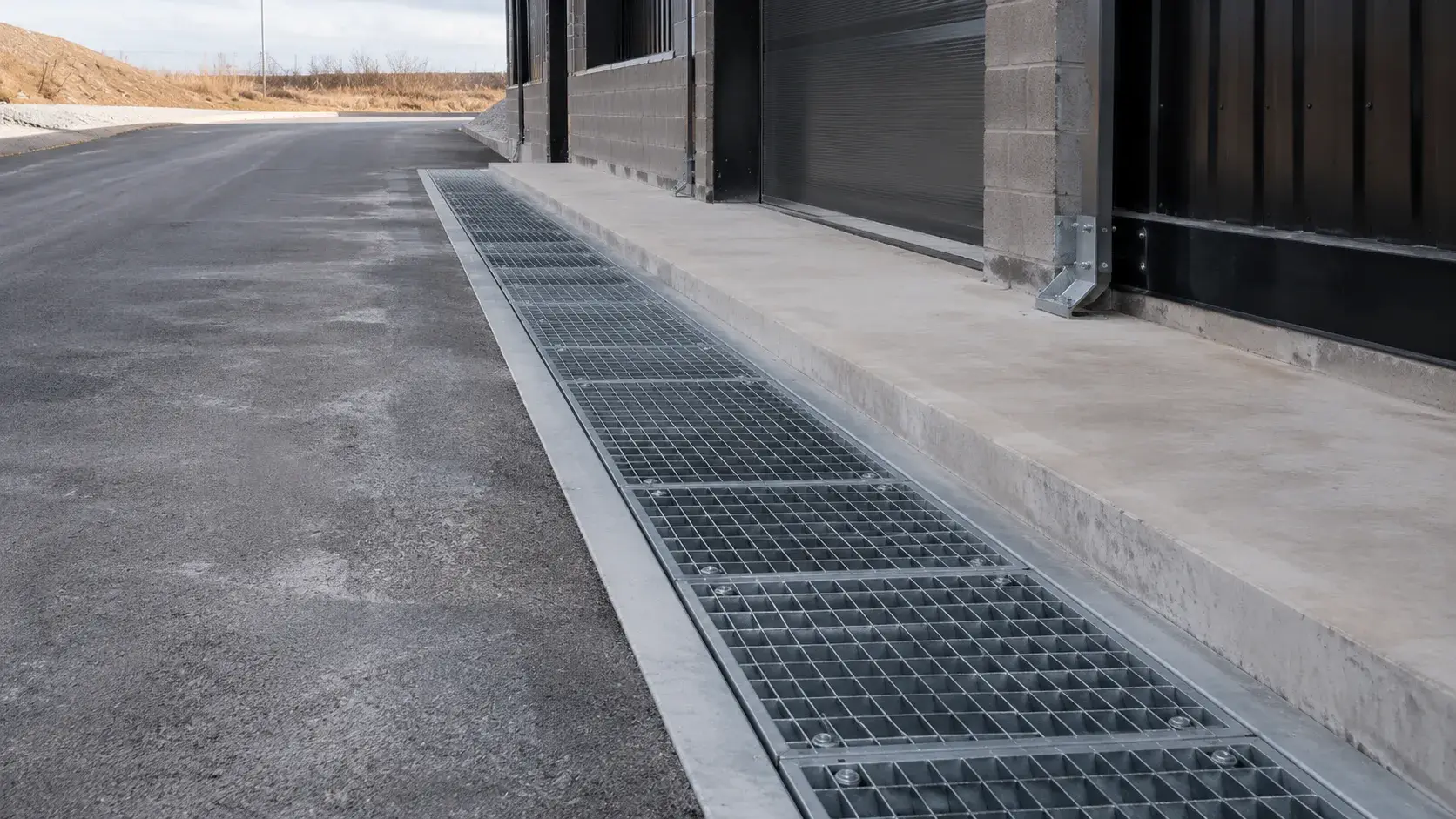
Heavy-Duty Grates for Forklift Warehouse Floors
How to spec heavy-duty grates and forklift-rated grating for warehouse floors, wheel loads, load classes, bar sizing, deflection, anchorage and fatigue.
A grate that survives a 9,000 kg counterbalance forklift on paper can still crack, dish, or work loose in a year if it was specified around the wrong number. The most common error we see on warehouse and plant floors is teams sizing heavy-duty grates against total vehicle weight instead of the concentrated load that actually hits the bearing bars. Forklifts, reach trucks, AS/RS shuttles and loaded pallet jacks don't spread their mass evenly, they drive it through small, hard wheels.
Get the wheel load wrong and no amount of steel thickness will save the install.
This guide walks plant engineers, facility managers and specifiers through how to spec forklift-rated grating that holds up: why wheel load drives the decision, how load classes map to your traffic, how to size bearing bars and frames, and when a worn floor warrants a planned replacement instead of one-off patching.
Why wheel load, not vehicle weight, drives the spec
Grating fails locally, not globally. The deck doesn't feel a 7-tonne lift truck as a 7-tonne blanket load; it feels a series of point loads where each wheel meets the surface. A loaded forklift can put well over half its rated capacity plus its own weight onto a single front axle, and that axle splits between two contact patches the size of your palm. That concentrated load, often called the wheel load or patch load, is what bends bearing bars, not the truck's curb weight.
Small, hard polyurethane or cast wheels make it worse. The smaller the contact patch, the higher the local pressure and bending moment on individual bars. A pallet jack with 80 mm steel rollers carrying 2,000 kg can stress a bar harder per millimetre than a heavier truck on large pneumatics. When you brief us, give us the worst case: max wheel load, wheel/roller diameter and width, and whether the unit is steered or braking over the grate (turning and braking add side and impact loads).
We translate that into a deck that works, and we issue drawings so your team can verify it.
Match the load class to your real traffic
Load classes give everyone a shared language for rating a floor, but they only help if you pick against actual operations rather than a guess. Our grate load class guide breaks the classes down in detail; our companion post on grate load classes explained covers how the ratings are derived. The short version: pedestrian and light-cart areas sit at the low end, while forklift aisles, dock approaches and AS/RS lanes sit firmly at the heavy and extra-heavy end.
| Traffic type | Typical concern | Spec direction |
|---|---|---|
| Foot + hand carts | Slip, comfort | Light-duty deck, fine spacing |
| Pallet jacks (electric/manual) | Small hard rollers, point load | Heavier bars, tighter spacing |
| Counterbalance forklifts | High wheel load + braking | Heavy-duty bearing bars, banded edges |
| Reach trucks / AS/RS shuttles | Repeated passes, fatigue | Heavy deck + robust frame, fatigue allowance |
If a single floor sees mixed traffic, we spec to the heaviest realistic case in that zone rather than averaging it down. Under-spec'ing the busy lane to save weight everywhere is a false economy.
Sizing bearing bars and spacing
Three variables do most of the work in a forklift-rated deck: bearing bar depth, bar thickness, and clear spacing between bars. Depth governs stiffness and deflection, deeper bars resist bending far more efficiently than thicker shallow ones. Thickness adds capacity and fatigue margin.
Spacing matters because a small, hard wheel can bridge only so many bars; if your wheel or roller is narrow relative to the pitch, more of its load lands on fewer bars, so we tighten the spacing or add cross bars to share it.
For most forklift and AS/RS floors we lean toward heavier bar grating with deeper bearing bars and a span kept short by intermediate supports. Where wheels are very small or the surface needs to feel solid underfoot, a closer pitch or a custom metal grate layout makes more sense than forcing a stock pattern. Traction is a separate decision: high-traffic ramps and dock edges usually justify anti-slip grating so braking trucks and walking staff both keep their footing.
Frames, anchorage and deflection
A perfectly sized deck still fails if the frame and anchorage can't take the same beating. Repeated forklift passes try to walk panels out of their seats, hammer the edges, and pump any loose frame against the slab. We design the embedded or surface frame to match the deck's load class, with anchorage detailed for the dynamic, off-centre loads that vehicles apply, not just static weight.
Deflection is the limit that keeps a "strong enough" floor from feeling alive. A deck can be well under its stress limit and still flex enough to feel springy, rattle, or fatigue its welds over time. We hold deflection to a conservative fraction of span for trafficked floors so panels stay flat, seat tightly, and don't telegraph movement to operators.
Edge banding and toe plates protect the perimeter where wheels climb on and off, the spot that takes the most abuse on any access platform or floor opening. For pits and channels that also handle runoff, the same logic carries into trench drain grates and catch basin grates, which often sit right in the forklift path and must be rated accordingly.
Fatigue: the slow failure most specs ignore
A grate rated for a single heavy pass is not automatically rated for a million of them. Repeated loading drives fatigue, micro-cracks that start at welds, bar ends and anchor points and grow until a bar splits or a panel loosens. High-cycle lanes (main forklift aisles, AS/RS runs, dock approaches) need a fatigue allowance baked into bar sizing, weld detailing and anchorage, not just a one-time strength check.
This is exactly the kind of detail we work through with your engineers before fabrication, so the floor that passes inspection on day one still passes in year five.
We work from drawings, yours and ours
Every heavy-duty grate and fabrication we build is backed by full structural and shop drawings, and we'll collaborate directly with your design team to get there. Hand us your floor plans, equipment data and load criteria and we'll mark up spans, bar sizes, frame details and anchorage, then issue shop drawings for sign-off before a single bar is cut, nothing goes to the shop floor on a verbal spec.
If you're an engineer carrying the load calcs, our resources for engineers show how we document capacity and deflection; if you're an architect coordinating finishes and openings, our architect resources cover how grates integrate with the surrounding build. Either way, you get a paper trail you can stamp, file and hand to the next trade.
When to run a replacement program instead of patching
Worn grates rarely fail all at once, they degrade lane by lane. If your crews are tack-welding cracked bars, shimming loose panels, or swapping single grates every few months, you're spending more on reactive fixes than a planned upgrade would cost, and you're carrying a trip-and-collapse risk in the meantime. A structured grate replacement program lets you survey the floor, prioritize the heaviest lanes, and re-deck in scheduled phases with correctly rated panels.
Our facility manager replacement checklist is a good starting point for triaging what to fix first.
Beyond the deck itself, the same shop builds the structure around it, structural steel fabrication, metal stairs and railings and handrails, so a platform, mezzanine edge or pit can be upgraded as one coordinated package rather than a stack of mismatched parts. We fabricate in-shop in Ontario, ship across Canada, and offer supply-only or supply-and-install. Learn more about The Grate Guys or tell us what your floor is carrying.
Specifying heavy-duty grates for a forklift or high-traffic floor? Send us your wheel loads, equipment and floor plans and we'll spec it, draw it, and quote it. Explore our heavy-duty grates or contact us to start.
Get a quote for your project
Send sizes, quantities, and your deadline. We review it and reply with the next step.