
Types of Metal Grating: How to Choose
A practical buyer's guide to the types of metal grating, bar, heavy-duty, perforated, wire mesh and plank, and how to choose by load, open area, slip and budget.
The wrong grate is an expensive mistake you only notice after it ships. A specifier picks a product off a generic catalogue page, the load class is too light for the forklift traffic that actually crosses it, the bar spacing lets debris fall straight through into the drain it was meant to protect, and now there's a torn-out section, a near-miss incident report, and a rush re-fab on the schedule.
Most of these problems trace back to one decision made too early: choosing the wrong type of metal grating before anyone looked hard at the load, the open area, the debris, and the budget together.
This guide walks through the main types of metal grating, bar grating, heavy-duty grating, perforated metal, woven and welded wire mesh, and plank grating, and gives you a straightforward way to choose. The goal isn't to push one product. It's to help engineers, architects, contractors and facility managers match the grate to the job the first time.
The five main types of metal grating
Bar grating
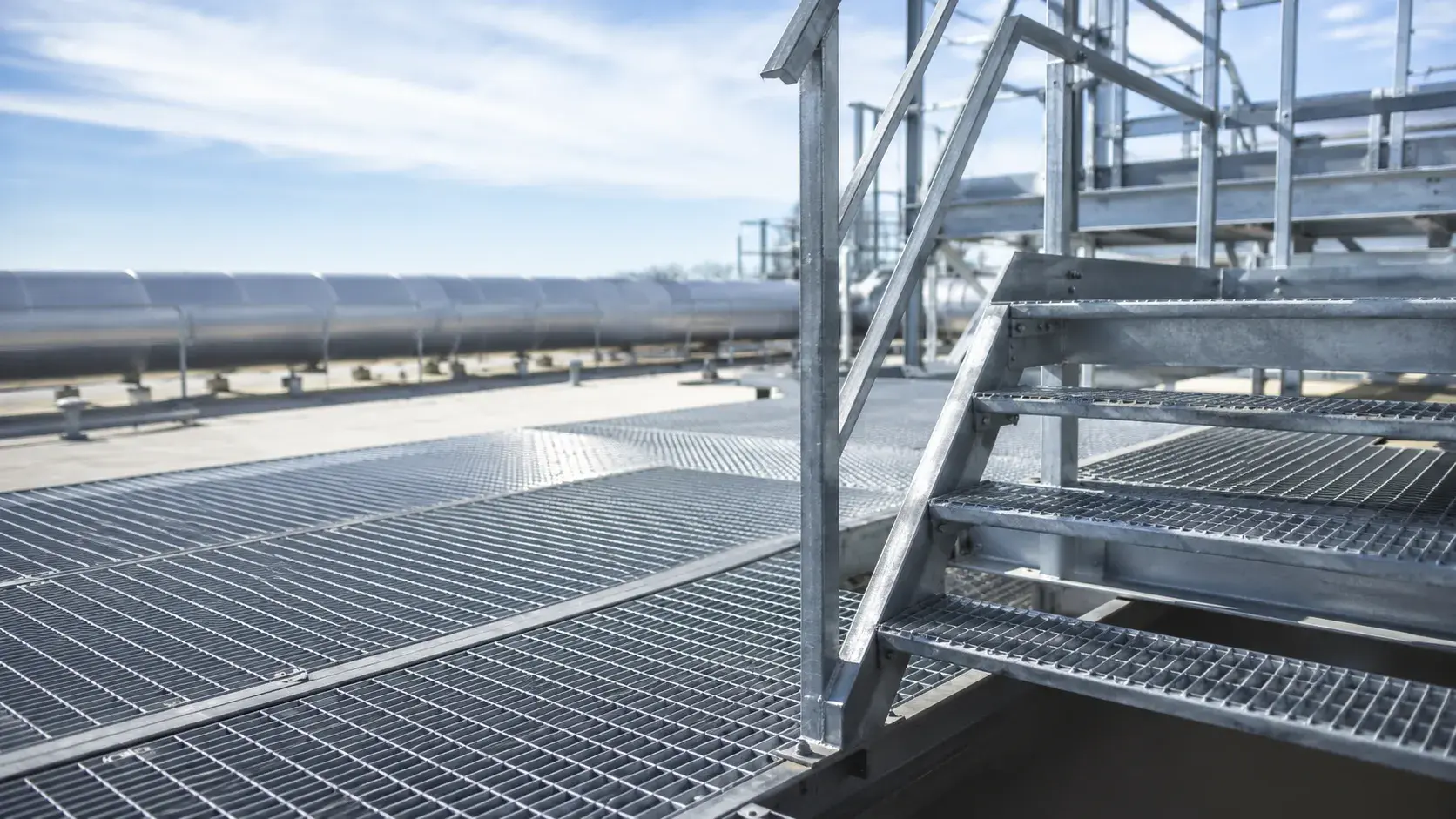
Bar grating is the workhorse of industrial flooring: load-bearing bars set on edge, cross-connected by perpendicular bars or rods. It delivers an excellent strength-to-weight ratio, high open area (typically 60-75%), and predictable load behaviour, which is why it dominates walkways, mezzanine decks, and pit covers. Welded bar grating handles the heaviest spans; swage-locked and press-locked versions trade some capacity for a cleaner look.
If you're not sure where to start, bar grating is usually the default to beat. For the slip-resistance side of the decision, serrated surfaces and dedicated anti-slip grating options matter most in wet, oily or freeze-thaw environments.
Heavy-duty grating
When the loads stop being foot traffic and start being loaded forklifts, AWP wheels, or vehicular crossings, you move into heavy-duty grating. This isn't a different family so much as bar grating engineered with taller, thicker bearing bars and tighter spacing to carry concentrated wheel loads across longer clear spans. The deciding factor is almost always the point load and span combination, which is exactly what a proper load class guide exists to pin down before you commit to a profile.
Perforated metal
Perforated metal is a solid plate punched with a pattern of holes. It gives you the most design control, round, square or slotted holes, tight or open patterns, and a flush, finished appearance that architects favour for screens, sunshades and feature flooring. The trade-off is open area and capacity: perforated sheet rarely matches bar grating for heavy structural loads, and clogging depends entirely on hole size versus the debris on site.
It shines in architectural metal screens and decorative applications where the look carries equal weight to the load.
Woven and welded wire mesh
Wire mesh, woven (interlaced wires) or welded (resistance-welded at each intersection), is the lightweight option. It's common for infill panels, guarding, partitions and security screens rather than primary walking surfaces. Welded mesh holds its shape and squareness under handling; woven mesh offers finer, more uniform apertures. Neither is your choice for a loading-dock floor, but both are efficient where you need an open barrier, airflow or visibility without supporting significant weight.
Plank grating
Plank grating is roll-formed from a single sheet into interlocking planks with raised, often perforated, walking surfaces. It installs fast, has a low profile, and gives a comfortable, near-solid feel underfoot, ideal for catwalks, stair treads and platforms where workers spend their day on their feet. Open area is lower than bar grating, so it's less suited to applications that need to shed water or debris aggressively.
How to choose: the six factors that actually decide it
Picking among the types of metal grating comes down to weighing six factors against each other. Rank them for your project before you look at any product page:
- Load, Uniform foot traffic, concentrated wheel loads, or vehicular? Get the load class right first; everything else is secondary. See load classes explained.
- Open area, How much water, light or air needs to pass through? Bar grating wins; plank and perforated trail.
- Debris, Will leaves, gravel or production scrap fall through and clog what's below? This drives bar spacing and hole size, and it's central to trench drain grates and catch basin grates.
- Slip resistance, Wet, oily or icy surfaces call for serrations or dedicated anti-slip treatment.
- Aesthetics, Visible, public-facing installs lean toward perforated and architectural finishes.
- Budget, Material, fabrication and finish all move the number. Galvanizing, stainless and powder coat each carry different costs and lifespans, covered in our finish comparison.
Comparison table: metal grating types at a glance
| Type | Load capacity | Open area | Debris shedding | Slip resistance | Best for | Relative cost |
|---|---|---|---|---|---|---|
| Bar grating | High | High (60-75%) | Excellent | Good (serrated) | Walkways, mezzanines, pit covers | Moderate |
| Heavy-duty grating | Very high | Moderate-high | Excellent | Good (serrated) | Forklift, AWP, vehicular crossings | Higher |
| Perforated metal | Low-moderate | Variable (pattern-driven) | Depends on hole size | Moderate | Screens, sunshades, feature floors | Moderate |
| Wire mesh | Low | High | Good | Low (not a primary surface) | Infill, guarding, partitions | Low |
| Plank grating | Moderate-high | Low-moderate | Moderate | Very good (raised surface) | Catwalks, stair treads, platforms | Moderate |
Every grate we build comes with full drawings
Choosing a type is the start; getting it built right is the rest. We work directly with the engineers and architects on a project, and we produce complete structural and shop drawings for every grate and fabrication that leaves our shop, bearing bar sizing, span and load calculations, connection and banding details, and dimensioned layouts for your review and sign-off. If you bring stamped drawings, we fabricate to them; if you're still specifying, we'll detail it with you.
That paper trail is what keeps a grate from being a guess. Engineers can see how we handle takeoffs and submittals on our resources for engineers, and architects can review how we treat finish and detailing on the page for architects.
Matching the grate to the rest of the build
Grating rarely lives alone. A mezzanine deck ties into the structural steel below it, the metal stairs that reach it, and the railings and handrails around it. Clean-environment work often pushes you toward stainless steel floor grates. Because we handle custom metal fabrication in-shop, we can build the grate and the surrounding steel to one coordinated set of drawings rather than stitching together parts from different suppliers.
If you're replacing rather than building new, start with a clean measurement, our measuring guide walks through it.
Choosing with confidence
There's no single best grate, only the right grate for your load, open area, debris, slip and budget. Rank those six factors honestly, use the table to narrow to a type, then confirm the profile against a real load class rather than a hopeful guess. When you're ready to spec it for your site, we'll detail and fabricate it to match.
Tell us your load, span, environment and finish, and we'll engineer and quote the right grate for your project, supply-only or supply-and-install, fabricated in our Ontario shop and shipped across Canada. Explore custom metal grates or get in touch to start your drawings.
Get a quote for your project
Send sizes, quantities, and your deadline. We review it and reply with the next step.