Anti-Slip Serrated Grating: Where Traction Matters
How anti-slip and serrated grating cut slip-and-fall risk on wet, oily and icy industrial platforms, catwalks and stairs. Spec guidance from a Canadian fab shop.
On a wet platform above a process line, the difference between a near-miss and a lost-time injury is often measured in millimetres of traction. Anti-slip grating exists for exactly that moment, the boot that lands on an oily catwalk, the worker carrying a load down open stairs in a January storm, the contractor stepping onto a mezzanine slick with coolant.
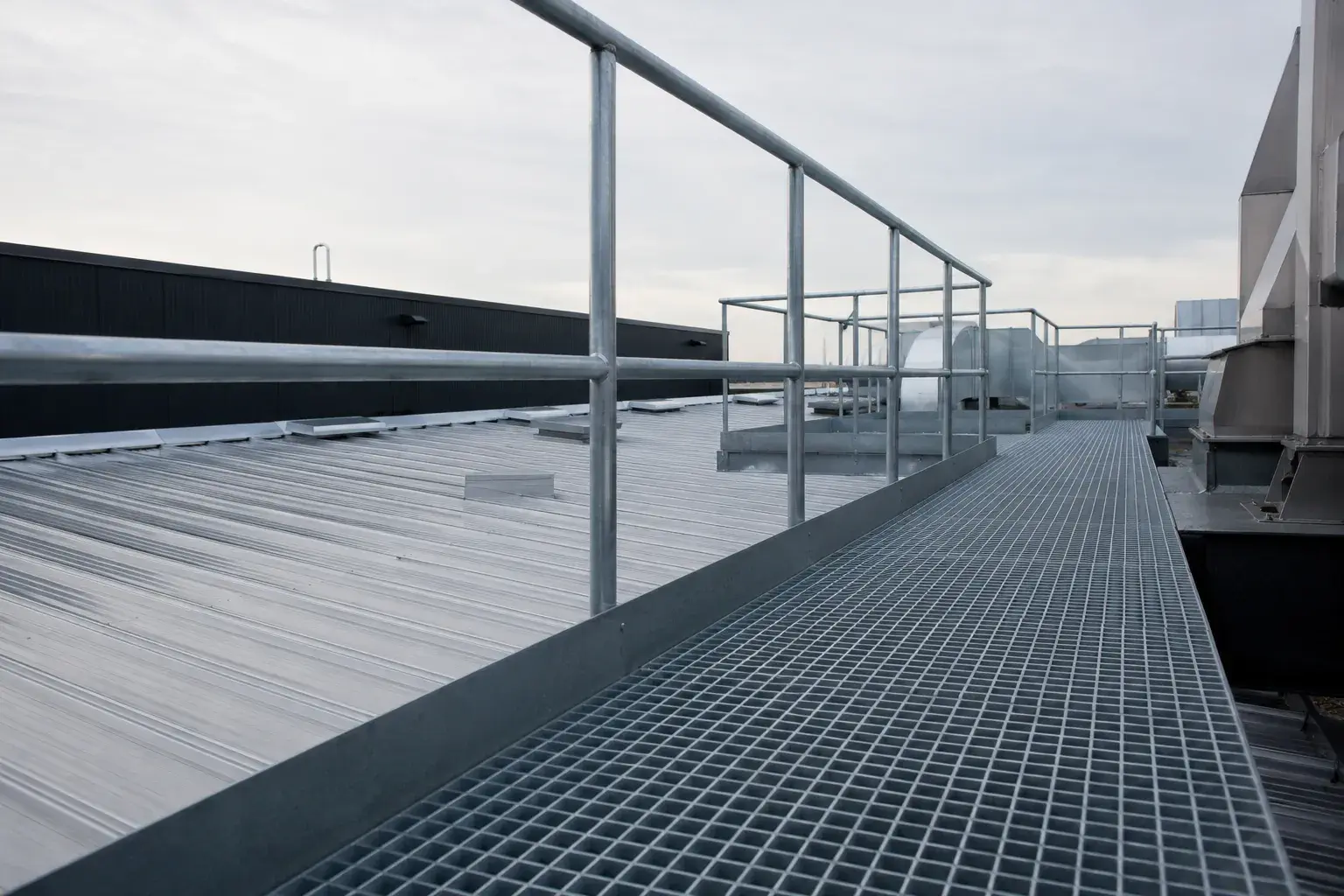
If your facility has elevated walkways, drainage zones, or floors that get wet, oily or icy, the grating underfoot is a safety control, not just a structural one. This guide walks through how serrated and abrasive-coated grating actually generate traction, where each option earns its keep, and how to pair it with compliant stairs, railings and platforms so the whole system protects people.
Why Anti-Slip Grating Is a Safety Decision, Not a Finish
Slips, trips and falls remain one of the most common sources of serious workplace injury across Canadian industry, and elevated work surfaces concentrate the risk. Under general workplace-safety expectations and working-at-heights practice in Ontario, an employer is responsible for providing a safe means of access and egress and for controlling foreseeable hazards, and a walking surface that loses grip when contaminated is a foreseeable hazard.
That is the lens we ask engineers and facility managers to bring to a grate spec: the question is not only "will it carry the load?" but "will it hold a boot when it's covered in what this area actually produces?"
Plain, smooth bar grating performs well dry. Introduce water, hydraulic oil, glycol, food fats, drilling fluids, or a skin of frost, and the contact patch between sole and steel can shear away. Anti-slip and serrated products are engineered to break through that contaminant film and bite into the boot, which is why specifying them on the right surfaces is one of the highest-leverage safety upgrades a plant can make.
Serrated vs. Plain Bar Grating
The most common upgrade to standard bar grating is serration. Instead of a flat top edge on each bearing bar, serrated grating has a notched, tooth-like profile machined along the top. Those teeth do two things: they create dozens of small edges per square foot that cut into the contaminant film, and they channel liquid away from the contact point so the boot meets metal rather than a slick layer.
- Plain (smooth-top) grating, Best for dry interior areas, lighter foot traffic, and locations where a clean top surface matters for rolling carts or trip-edge concerns. Lowest cost, easiest to keep clean.
- Serrated grating, The default for catwalks, process platforms, loading areas and any exterior or wash-down environment. Markedly better wet and oily traction, with a modest reduction in open area and a slightly higher cost.
Serration is available across most welded and pressure-locked bar grating, in carbon steel, galvanized, aluminum and stainless. Because we fabricate in-shop, we can serrate the runs that need it and leave others plain within the same order, useful when a single platform mixes a dry tool area with a wet process bay.
Abrasive Coatings and Other Traction Surfaces
Where serration alone is not enough, steep ramps, areas with persistent oil or fine debris, or surfaces walked in lighter footwear, an abrasive anti-slip surface adds aggressive, sandpaper-like grit bonded to the walking plane. This is common on stair treads, ramp covers and entry platforms. Perforated and plank-style planks with raised, punched buttons (often called grip-strut style) are another option, giving a self-cleaning, all-direction grip that sheds snow and shavings well.
The right choice depends on the contaminant, the slope, the cleaning regime, and how much open area you need for drainage and light. We help you weigh those trade-offs against your load class and span before anything is cut.
Traction in the Real World: Ice, Snow, Oil and Wash-Down
Different contaminants defeat traction in different ways, and the best surface depends on what your floor actually sees:
- Ice and snow (exterior platforms, fire escapes, rooftop access): Open grating already outperforms solid plate because precipitation falls through rather than pooling and freezing on top. Pair that open area with serration or grip-strut planks so the edges break through any glaze that does form. This is a frequent driver for upgrading exterior access platforms and stairs in Canadian climates.
- Hydraulic oil and coolant (machine shops, process lines): Serration plus a generous open area lets fluid drain off the walking surface instead of building a film. For the worst cases, an abrasive tread surface is the more reliable control.
- Wash-down and food/beverage floors: Stainless serrated grating resists corrosion from cleaning chemicals while keeping grip during and after wash cycles, relevant for clean-room and hygienic environments.
- Drainage zones: Where water is constant by design, the grating is part of the drainage system. Serrated trench drain grates and catch basin grates keep traction while moving volume.
Grating Is Only as Safe as the Stairs and Railings Around It
A high-traction platform deck does little good if the route to it fails. Slip-and-fall prevention is a system: the deck, the treads, the handhold, and the fall protection all have to work together. Anti-slip and serrated grating should be specified alongside the access components that share the same hazard.
- Metal stairs, Stair treads are where falls turn serious. Serrated or abrasive-tread grating treads, with consistent rise and run and appropriate nosing, keep footing predictable on the descent, when most falls happen.
- Railings and handrails, A continuous, properly mounted handrail and guard is the catch when traction is lost. Open-edge platforms and stairs need guarding that matches working-at-heights expectations.
- Access platforms and mezzanines, Decking, toe boards, guarding and access stairs designed as one assembly remove the weak links between components.
Because we handle both the grating and the surrounding structural steel fabrication, the deck, stairs and railings are detailed to fit together rather than being cobbled from separate suppliers. That coordination is where a lot of real-world trip hazards, mismatched heights, gaps at landings, awkward transitions, quietly get designed out.
Full Structural and Shop Drawings on Every Job
We do not ask you to spec traction from a catalogue thumbnail and hope it fits. Every grate and fabrication we build is documented with complete structural and shop drawings before steel is cut, so the people responsible for the space can review exactly what they are getting.
We work directly with your engineering team and architects, sizing bearing bars and spans to the intended load, marking out serration and anti-slip surfaces panel by panel, calling out fastening and clips, and detailing how the grating ties into stairs, platforms and supports. Drawings go out for your stamp and sign-off, revisions are captured, and the approved set drives the shop.
If a load condition or contaminant changes the right surface, that conversation happens on paper first, not after installation, when fixing it is expensive and the platform is already in service.
Specifying the Right Surface for Your Facility
A practical way to approach an anti-slip grating spec:
- Map the contaminant. Water, oil, ice, fats or fine debris each point to a different surface, serration, abrasive tread, or grip-strut.
- Confirm the load and span first. Traction is layered on top of structural capacity; use the load class guide and our explainer on how load classes work to set the baseline.
- Match the material to the environment. Our metal and finish guide and post on galvanized vs. stainless vs. powder-coated grates cover corrosion and wear trade-offs.
- Treat access as part of the deck. Spec the stairs and railings to the same standard as the platform.
Whether you need a single serrated custom grate or a full platform-and-stair assembly, we build to your drawings in-shop and ship across Canada, supply-only or supply-and-install.
Need higher traction underfoot? Explore our anti-slip grating options or contact The Grate Guys to talk through your platforms, catwalks and stairs. Start at our homepage to see the full range.
Get a quote for your project
Send sizes, quantities, and your deadline. We review it and reply with the next step.