
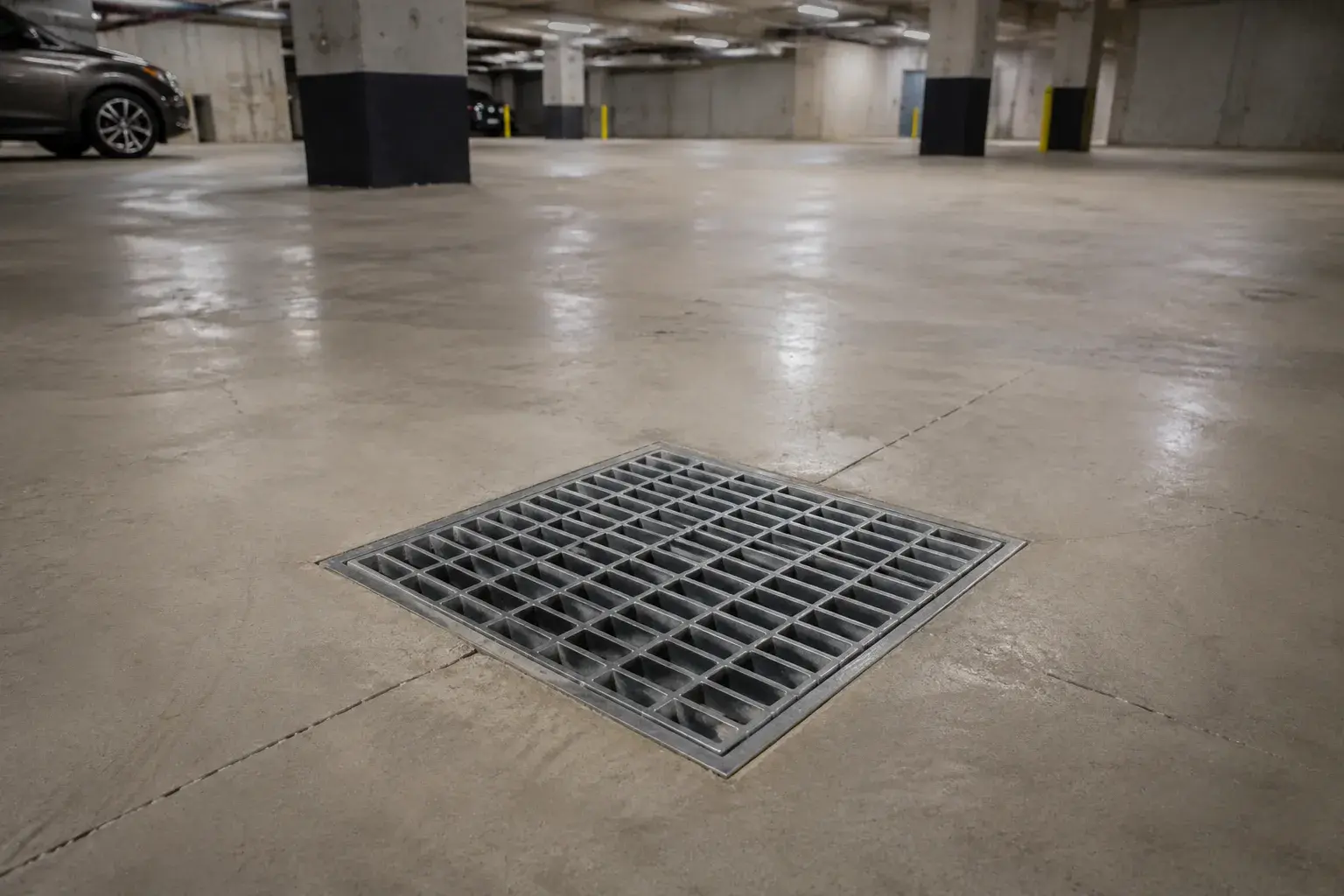
Catch Basin Grates: Load Class and Frames
How to select catch basin grates and municipal drainage grates by traffic load class, with bicycle-safe openings, frame anchoring, hot-dip galvanizing and drop-in replacements.
A catch basin grate is one of the smallest items on a municipal drawing and one of the most exposed to liability. It sits at the low point of a road, a parking lot or a yard, takes every wheel load that crosses it, and is the one casting a cyclist or pedestrian actually puts a tire or a foot on.
Get the catch basin grates wrong, too coarse an opening, the wrong load class, a frame that rocks, and you've built a maintenance headache and a claim waiting to happen.
This guide walks municipal engineers, civil engineers, public-works managers and site contractors through selecting catch basin grates, manhole covers and trench covers for municipal and site work: load class by traffic, bicycle-safe and accessible openings, frames and anchoring, hot-dip galvanizing for longevity, spec considerations, and drop-in replacements for damaged castings.
Choosing Load Class by Traffic
The first decision with any municipal drainage grate is load class, and it should be driven by the heaviest wheel load that will cross the grate, the frequency of that load, and the dynamic impact factor, not by what looks "heavy enough."
A grate set in a landscaped boulevard sees a fraction of the duty that one in a truck-route gutter line or a heavy-civil yard entrance does, and specifying a single product across all of them either over-builds the light locations or under-builds the critical ones.
| Location | Typical traffic | Load consideration |
|---|---|---|
| Pedestrian areas, boulevards, plazas | Foot traffic, occasional maintenance vehicle | Light duty; opening safety governs |
| Parking lots, driveways, residential streets | Cars, light trucks | Medium duty with deflection limits |
| Collector and arterial roads | Buses, loaded trucks, constant cycling | Heavy duty, high cycle count, impact-rated |
| Industrial yards, heavy-civil entrances, ports | Loaded trucks, container handlers, tracked plant | Heavy-duty grates; point load and impact critical |
If you're matching a duty category to real wheel loads, work from our grate load class guide, and the companion article on grate load classes explained shows how to read those classes against a live spec. For the most demanding road and yard locations, heavy-duty grates with deeper bearing bars and tighter spacing are the correct call rather than a lighter grate pushed past its rating.
Bicycle-Safe and Accessible Openings
Load class keeps the grate from failing under traffic; opening geometry keeps it from hurting the people using the road around it. The classic failure is a gutter grate with bars running parallel to the curb, a perfect slot to swallow a bicycle wheel. On any route shared with cyclists, the opening pattern has to be bicycle-safe: bars oriented across the direction of travel, or a cross-bar pattern that closes the gap so a narrow tire can't drop in.
The same logic applies to accessibility. In sidewalks, transit stops, plazas and any accessible route, the clear opening should be limited so that canes, walker tips, heels and small wheels can't catch, commonly held to roughly 13 mm in the direction of travel.
We can fabricate catch basin grates and tree grates with heel-proof, bicycle-safe and accessible opening patterns to suit the location, and pair them with anti-slip grating surfaces where the grate sits on a pedestrian path that ices or stays wet.
Frames and Anchoring: Where Grates Actually Fail
Most callbacks on catch basins trace back to the frame, not the grate. A frame that isn't anchored to develop the load into the structure lets the grate rock under every axle, and that rocking hammers the concrete collar, spalls the surround, loosens the casting and eventually throws the grate out of seat, the exact condition that produces complaints and trip hazards.
The frame has to seat the grate tight and rattle-free, with anchor legs or studs developing the full load path into the basin or slab and adequate concrete cover around them.
We fabricate the frame and grate as a matched assembly so the seat tolerance is controlled in the shop rather than fought in the field. Where the basin ties into adjacent steelwork, pit surrounds, headwalls, equipment bases or a continuous gutter line, we can detail it alongside the surrounding structural steel fabrication and broader custom metal fabrication so the whole assembly is coordinated as one.
The same approach extends to manhole covers and trench covers, which live or die on the same frame-and-seat detailing as catch basin grates.
Hot-Dip Galvanizing for Longevity
Exposure outdoors, salt spray and winter de-icing chemicals are brutal on uncoated steel, so finish is not a cosmetic decision on municipal work, it's what determines service life. Hot-dip galvanizing is the workhorse finish for catch basin grates and frames: the zinc coating is metallurgically bonded, self-heals minor scratches sacrificially, and holds up through years of road salt and standing water far better than paint.
For most roadway, parking and yard drainage, hot-dip galvanized grates are the right specification.
Where the chemistry is harsher, coastal salt, frequent caustic or acidic exposure, or hygiene-critical areas, galvanizing can be attacked and stainless becomes the better answer, the same way it does for indoor stainless steel floor grates. Our comparison of galvanized vs. stainless vs. powder-coated grates and the metal and finish guide help you match the finish to the actual environment rather than defaulting to one option everywhere.
OPSS and Municipal Spec Considerations
Municipal drainage work is typically governed by your jurisdiction's standards and the project drawings, OPSS-style specifications, regional standard details and the engineer's particular requirements for load class, opening pattern and finish. We are a metal fabrication shop, so we don't claim a certification or an official listing for our castings; what we do is fabricate to the municipal standards and drawings you provide.
Give us the load class, opening geometry, frame and anchoring detail and finish called out on your plan, and we build the grate, frame, manhole cover or trench cover to match it.
That distinction matters on tender work. Where a standard detail calls for a specific clear opening, bar pitch, seat depth or anchorage, we fabricate to that detail and produce drawings showing exactly how we've met it, so the reviewing engineer can confirm conformance before anything ships. If the standard product on the market doesn't fit your geometry, that's precisely where our custom metal grates capability comes in.
We Work From Your Drawings, and Produce Our Own
Every catch basin grate, manhole cover, trench cover and frame we fabricate is backed by complete structural and shop drawings, developed in direct collaboration with your design team. We mark up bearing-bar sizing, load paths, anchor and seat details, opening geometry and grate-to-frame tolerances, then issue them for your review before we cut steel, so conformance to your spec is confirmed on paper, not discovered at the pour or the install.
If you're an engineer setting load class and deflection criteria, our page for engineers shows how we work to a specification; if you're an architect coordinating visible grates in a public realm, our page for architects covers detailing to design intent. Site contractors managing the install will find our general contractors page covers field fit and delivery.
Custom and Drop-In Replacements for Damaged Castings
You rarely need to dig out a sound basin to fix a broken grate or a cracked casting. In most cases we can fabricate a drop-in replacement grate, and a new frame where the original is corroded or spalled, to match the existing opening, load class and seat detail, so the basin stays in service and the road reopens faster. Cast-iron grates that have cracked, gone missing, or rusted into the frame are ideal candidates for a fabricated steel replacement built to the same footprint.
The whole job hinges on accurate field measurement; our guide on how to measure a replacement grate walks through capturing the clear opening, seat depth and frame detail correctly the first time. For public-works departments and property managers running this across many basins, our grate replacement programs handle it as a coordinated rollout rather than one emergency at a time, and the property managers page covers how we schedule multi-site work.
Pairing Catch Basins With the Rest of the Drainage System
Catch basins almost never work alone. They tie into gutter lines, channel drains and area drains, and the transitions between them are where flow and detailing have to agree. Where a basin connects to a linear run, we coordinate the catch basin grates with the adjacent trench drain grates so the load class, opening pattern and seat heights stay consistent across the system.
For the full picture, how catch basins, trench and channel components fit a site together, our drainage solutions hub lays out the options.
Whether you're specifying new basins from a standard detail or replacing castings that have already failed, the discipline is the same: rate for the real traffic load, choose openings that are safe for cyclists and pedestrians, anchor the frame to develop the load, galvanize for longevity, and build to your drawings. We fabricate all of it in-shop in Ontario and ship across Canada, supply-only or supply-and-install.
Ready to specify or replace municipal drainage grates? Explore our catch basin grates or contact The Grate Guys with your load class, opening requirements and frame detail, and we'll produce drawings for your review. Start at our homepage to see the full fabrication range.
Get a quote for your project
Send sizes, quantities, and your deadline. We review it and reply with the next step.