
Expanded Metal vs Bar Grating: How to Choose
Expanded metal vs bar grating compared: load capacity, open area, cost, traction, and appearance, so you pick the right one for walkways, platforms, security, or screening.
Choose bar grating when load capacity and clear span matter most: walkways, work platforms, mezzanines, trench covers, and anywhere people or equipment carry real weight. Choose expanded metal when you need a lighter, lower cost sheet for security screens, machine guards, infill panels, fencing, and ventilated covers. If the part has to hold a person or a load across a span, start with bar grating. If it mostly has to cover, screen, or guard an opening, start with expanded metal.
Both are staples in our shop, and the right pick usually comes down to how much weight the part carries, how much open area you want, and how it needs to look. Below is how a fabricator actually decides.
What Expanded Metal Is
Expanded metal starts as a solid sheet of steel, aluminum, or stainless. A press simultaneously slits and stretches the sheet, opening it into a pattern of diamond shaped strands and bonds. Because nothing is cut away, there is no waste and the sheet stays a single continuous piece, which is part of why expanded metal is economical.
There are two main forms:
- Raised (standard) expanded metal. Straight off the press, the strands sit at an angle to the plane of the sheet. This creates a naturally aggressive, self cleaning surface with excellent grip, which is why it shows up on ramps, running boards, and stair treads.
- Flattened expanded metal. The raised sheet is passed through a cold roll that presses the strands flat into one plane. This gives a smoother, more uniform surface that is easier to walk on in socks or soft soles and looks cleaner as an architectural panel, at the cost of some traction and a little strength.
Expanded metal is specified by the size of the opening and the thickness of the original sheet. Heavier gauges behave almost like a light structural panel, while thin sheets act more like a rigid mesh for screening and guarding.
What Bar Grating Is
Bar grating is an engineered assembly of load bearing bars set on edge and running in the direction of the span, tied together by cross bars at regular intervals. Setting the bars on edge is what gives grating its strength to weight advantage: the depth of the bar does the structural work while very little material sits in the walking surface.
The two common construction methods are:
- Welded bar grating. Cross bars are resistance welded across the tops of the bearing bars at each intersection, creating a rigid, permanently bonded panel. It is the workhorse for industrial floors, platforms, and heavy traffic.
- Pressure locked (swage locked) grating. Cross bars are mechanically pressed into slots in the bearing bars under high pressure, no welding required. This yields a clean, consistent appearance that suits architectural work and is available in aluminum and stainless as well as steel.
Grating is sized by bearing bar depth and thickness and by spacing. Deeper bars and tighter spacing carry more load across longer spans. For heavier requirements, see our heavy-duty grates.
Expanded Metal vs Bar Grating: Side by Side
| Factor | Expanded Metal | Bar Grating |
|---|---|---|
| Load capacity | Light to moderate. Best for panels and covers, not long unsupported spans. | High. Engineered to carry people, carts, and equipment across real spans. |
| Open area | Roughly 30 to 70 percent, depending on pattern and gauge. | Typically 70 to 80 percent or more, so it drains and passes air freely. |
| Cost | Lower material and fabrication cost, less steel per square foot. | Higher, more steel and more labor in the assembly. |
| Traction | Raised pattern grips very well; flattened is smoother and less aggressive. | Very good, and serrated bar options add slip resistance for wet or oily areas. |
| Appearance | Fine, uniform mesh look; reads as a screen or panel. | Bold linear pattern; reads as an industrial floor or platform. |
| Typical use | Security screens, guards, infill, fencing, ventilation, light covers. | Walkways, platforms, mezzanines, stair treads, trench and pit covers. |
When to Use Bar Grating: Walkways and Platforms
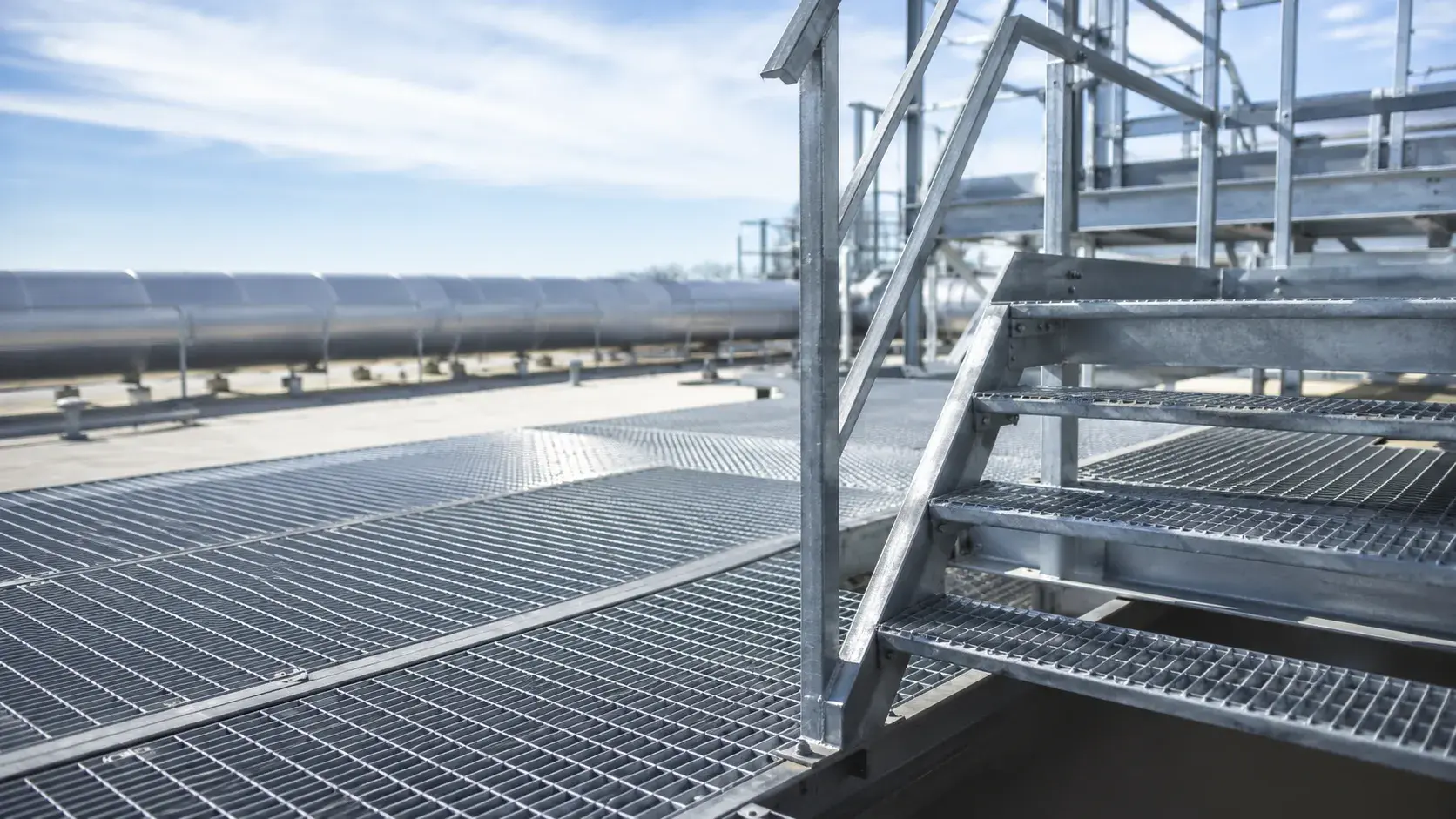
Reach for bar grating whenever the part is a walking or working surface that has to carry load safely. That covers elevated walkways and catwalks, mezzanine and platform flooring, stair treads, ramps, and trench, pit, and drain covers where forklifts or foot traffic pass over. Its high open area lets water, oil, snow, and debris fall straight through, which keeps surfaces from getting slick and reduces standing water on exterior platforms across the GTA.
Grating is also the right call when you need a defined load rating you can point to on a drawing. Bearing bar depth and spacing map directly to allowable loads and deflection, so a facility manager or engineer can specify a panel that meets a concentrated wheel load or a uniform live load with confidence. Explore our full range of bar grating and metal grates for these applications.
When to Use Expanded Metal: Security Screens and Infill
Expanded metal shines wherever you need to cover, screen, or guard an opening without the weight or cost of grating. Common uses include:
- Security screens and enclosures for windows, storefronts, tool cribs, and equipment cages, where a small opening stops intrusion but still lets air and sightlines through.
- Machine and safety guarding around moving equipment, conveyors, and electrical gear.
- Railing and fence infill panels where you want a see through but protective barrier that is lighter than grating.
- Ventilated covers and grilles for enclosures, HVAC returns, and equipment housings.
- Architectural facades, sunscreens, and privacy panels where the fine, consistent pattern is a design feature.
Because it comes from a single sheet, expanded metal has no welds or intersections to fail and is easy to form, curve, and cut into custom shapes. That makes it the efficient choice for large areas of screening. For anything outside standard sheet sizes, we build to spec, see custom metal grates.
Fabrication and Finishes
Both products come in carbon steel, aluminum, and stainless, and both can be finished for the environment they live in. For steel that will see weather or wash down, hot dip galvanizing after fabrication is the standard for corrosion protection, and it is what we recommend for most exterior GTA installations. Powder coat and paint add color and a cleaner look for architectural and interior work, and stainless is the pick for food, pharmaceutical, and marine settings where hygiene and corrosion resistance drive the spec.
On the fabrication side, bar grating is cut to panel size, then banded at the edges, notched around columns and penetrations, and fitted with hold down clips, saddle clips, or bolted connections so it seats securely and does not shift underfoot. Stair treads get nosing and end plates. Expanded metal is sheared to size and typically framed in angle or tube so the panel is rigid, safe to handle, and easy to mount. Getting these details right, banding, framing, clip layout, and finish, is where a fabrication shop earns its keep, because a correctly detailed panel installs faster and lasts far longer in the field.
How to Decide
Work through these questions in order and the answer usually becomes obvious:
- Will it carry load across a span? If people, carts, or equipment travel over it, choose bar grating. If it mostly covers or screens an opening, expanded metal is likely enough.
- How much open area do you need? For maximum drainage and airflow, grating wins. For a finer barrier that still breathes, expanded metal works well.
- What is the budget? For large areas that do not need to carry heavy load, expanded metal saves material and labor.
- How should it look? A bold industrial floor pattern points to grating; a fine, uniform screen or architectural panel points to expanded metal.
- What is the environment? Match the metal and finish to exposure, galvanized steel outdoors, stainless for hygiene, aluminum where weight matters.
When a project mixes both needs, it is common to use grating for the walking surfaces and expanded metal for the guards, infill, and screens around them. For a broader look at the options, see our guide to types of metal grating and how to choose.
Frequently Asked Questions
Is expanded metal strong enough to walk on?
Heavier gauge expanded metal, especially the raised pattern, is used for stair treads, ramps, and running boards and holds foot traffic well when properly framed and supported. For a floor or platform that carries carts, equipment, or a specified live load across a span, bar grating is the safer and more predictable choice.
Which is cheaper, expanded metal or bar grating?
Expanded metal is generally cheaper per square foot because it uses less steel and is faster to produce from a single sheet. Bar grating costs more because it is an assembly of bearing bars and cross bars, but you are paying for load capacity that expanded metal cannot match. The cheaper product is only the better value if it meets the load and function the job requires.
Can I use bar grating for a security screen?
You can, and pressure locked grating in particular makes a clean, rigid barrier. But grating is heavier and more expensive than needed for most screening, and its wide openings offer less of a barrier than a tight expanded metal pattern. For security screens, guards, and infill, expanded metal is usually the more efficient choice.
What finish should I use for outdoor installations?
For steel exposed to weather in the GTA, hot dip galvanizing after fabrication is the standard for long term corrosion protection. Powder coat can be added for color, aluminum is a good lightweight and naturally corrosion resistant option, and stainless is used where hygiene or aggressive environments demand it. We help you match the metal and finish to the site.
Not sure which one fits your project? Send us your drawings, load requirements, or a photo of the opening and our team will spec the right product, metal, and finish for the job. Contact The Grate Guys for a quote on custom expanded metal or bar grating fabricated in Toronto and delivered across Ontario.
Get a quote for your project
Send sizes, quantities, and your deadline. We review it and reply with the next step.