
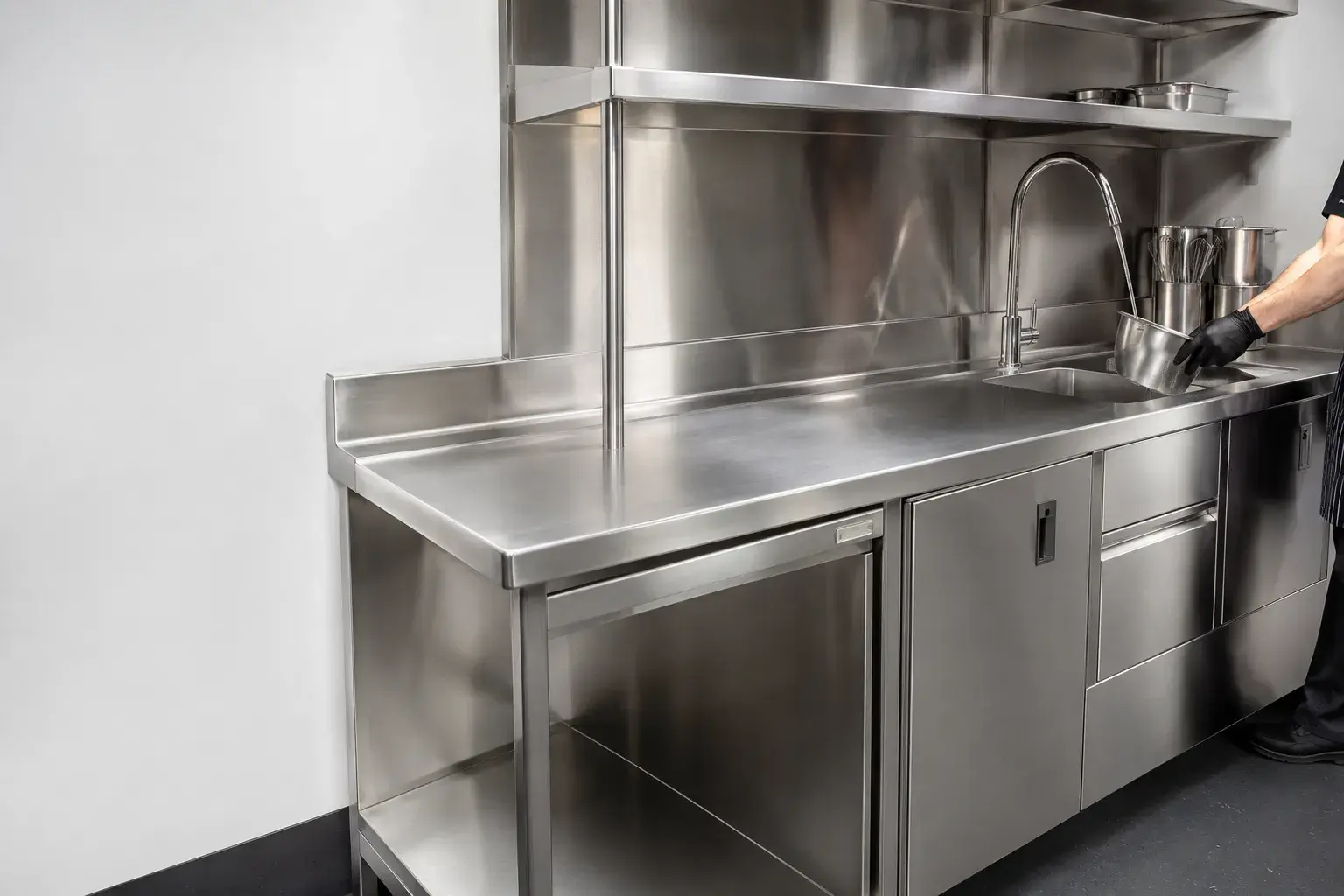
Stainless Cleanroom Grates and Sanitary Drainage
How to spec stainless cleanroom grates and sanitary drainage for pharma, food and biotech, 316 stainless, electropolishing, crevice-free welds, slope and cleanout.
In a pharma, food or biotech facility, the floor grate is one of the easiest places for a sanitation programme to fail an audit. A trapped weld seam, a rough mill finish, or a frame ledge that water never quite leaves becomes a harbourage point, and harbourage points become deviations. If you are specifying stainless cleanroom grates or sanitary drainage for a GMP-controlled space, the metallurgy, the finish, the opening geometry and the frame detailing matter just as much as the load class.
This guide walks through how we approach hygienic grate and drainage fabrication, and how to spec it to your own validation requirements.
Start with the alloy: why 316 stainless earns its place
For wash-down and chemically aggressive environments, 304 stainless is often not enough. Caustic CIP cycles, chlorinated sanitizers, brines and acidic process residues all push toward 316 (or 316L) stainless, where the added molybdenum improves resistance to pitting and chloride attack. The low-carbon 316L variant also reduces the risk of carbide precipitation at weld zones, which matters a great deal when corrosion resistance has to survive the heat of fabrication.
We fabricate stainless steel floor grates and sanitary drainage components in 316/316L as standard for these settings, and we are happy to work to whatever alloy your process chemistry and validation team specify. If you are weighing material options across the broader facility, our galvanized vs stainless vs powder-coated comparison and the metal and finish guide lay out the trade-offs.
Surface finish: electropolishing and the war on micro-roughness
Cleanability is largely a function of surface roughness. A mill-finish or as-welded surface holds soil and biofilm in microscopic peaks and valleys that no amount of scrubbing reliably reaches. For hygienic detailing we can supply mechanically polished surfaces and, where your spec calls for it, electropolished finishes that reduce surface roughness (Ra) and passivate the stainless in a single operation. A lower Ra means fewer places for residue to lodge and faster, more verifiable wash-down.
We will fabricate to a target Ra you nominate; the qualification of that finish against your cleaning validation remains yours to confirm.
Crevice-free welds and hygienic detailing
Welds are where good intentions go to die. A lapped joint, a stitch weld, or a weld left with spatter and discolouration creates exactly the crevices a sanitary design is meant to eliminate. Our approach to crevice-free hygienic welds is to grind and blend continuous welds flush, then polish (and electropolish where specified) so the joint reads as a single continuous surface rather than an assembly of parts.
Internal corners are radiused rather than left sharp, gaps are closed, and fasteners are minimized or sealed. This is the same hygienic detailing philosophy applied across our clean room solutions and broader custom metal fabrication work, design out the places that cannot be cleaned, rather than relying on cleaning to compensate.
Slot vs perforated openings: choosing a cleanable pattern
The opening geometry is a balance between drainage capacity, foot and cart traffic, debris capture and, critically, cleanability. A few patterns we commonly fabricate:
- Slotted openings drain efficiently and are straightforward to brush and rinse along their length, which is why they are popular in food process and wash-down zones. Slot width can be tuned to capture or pass debris depending on what your process generates.
- Perforated (round-hole) plates give a smooth, easily wiped top surface and a defined open area, suiting cleanrooms where a flush, low-profile surface is preferred.
- Bar grating offers high open area and load capacity; our bar grating can be specified in stainless with smooth or serrated bearing bars where slip resistance is a factor, see anti-slip grating for those options.
Whatever the pattern, the goal is the same: no blind pockets, accessible surfaces, and an open area matched to your hydraulic and sanitation needs. For trench applications, our trench drain grates and custom metal grates can be built to suit the channel and the cleaning regime together.
Drainage slope, cleanout and the frame that holds it all
A hygienic grate sitting over a poorly detailed channel still fails. Sanitary drainage wants positive slope so liquid clears completely rather than pooling, generous radii in the channel rather than square internal corners, and accessible cleanout points so the system can be inspected and sanitized end to end.
The frame is the most overlooked harbourage risk: a frame with a flat seating ledge that traps water under the grate, or an embedment detail with a gap to the surrounding floor or resin, undoes everything done above it. We detail frames to shed water, to sit cleanly against the finished floor system, and to minimize the under-grate void where soil collects. Removable grates that lift out without tools make routine deep-cleaning realistic rather than aspirational.
These same principles carry into our drainage solutions and catch basin grates for the less-controlled support areas of a plant.
Load class still matters, don't trade it away for hygiene
Hygienic detailing must not come at the cost of structural performance. Pallet jacks, IBC totes, mobile tanks and forklifts impose real loads, and a grate that deflects or rocks under traffic will eventually crack a weld or unseat from its frame, reopening the very crevices you engineered out. We size bearing bars, plate thickness and support spacing to the actual traffic, and document it.
If you are setting the duty, the grate load class guide and our load classes explained post translate the standards into practical specification language.
Full structural and shop drawings on every fabrication
We do not treat sanitary grates as catalogue commodities, and we do not ask you to reverse-engineer our intent on site. We work directly alongside your facility and QA engineers and architects, and we issue complete structural and shop drawings for every grate and fabrication before any steel is cut.
Those drawings spell out alloy and finish callouts, weld and radius details, opening pattern and open area, frame and embedment sections, slope and cleanout interfaces, and load assumptions, so your team has a documented, reviewable record to check against your GMP and sanitary design requirements, and to fold into your own validation and change-control package. Nothing reaches your floor that you and your reviewers have not first seen and approved on paper.
How to spec it to your GMP and sanitary requirements
We fabricate to GMP-style and sanitary design principles, 316 stainless, electropolished finishes, crevice-free welds, radiused corners and harbourage-minimizing frames, built to the details you and your specifiers define. To be clear and honest about scope: we are a metal fabrication shop, not a certification body, and the responsibility for compliance, qualification and validation against any GMP, 3-A or ISO standard rests with you and your quality team.
What we bring is the capability to translate a hygienic specification into accurately fabricated, fully documented stainless grates and drainage, supply-only or supply-and-install, fabricated in our Ontario shop and shipped across Canada. Bring us your cleaning regime, your load duty, your alloy and finish targets, and your facility drawings, and we will detail grates that fit the room and the requirement.
For the wider built environment around the wet process areas, we also fabricate stainless metal stairs, railings and handrails and access platforms to the same hygienic detailing standard.
Specifying stainless cleanroom grates or sanitary drainage for a pharma, food or biotech build? Explore our clean room solutions or contact The Grate Guys with your drawings and requirements, we'll detail, draw and fabricate to your spec. Or start at our homepage to see the full fabrication range.
Get a quote for your project
Send sizes, quantities, and your deadline. We review it and reply with the next step.