
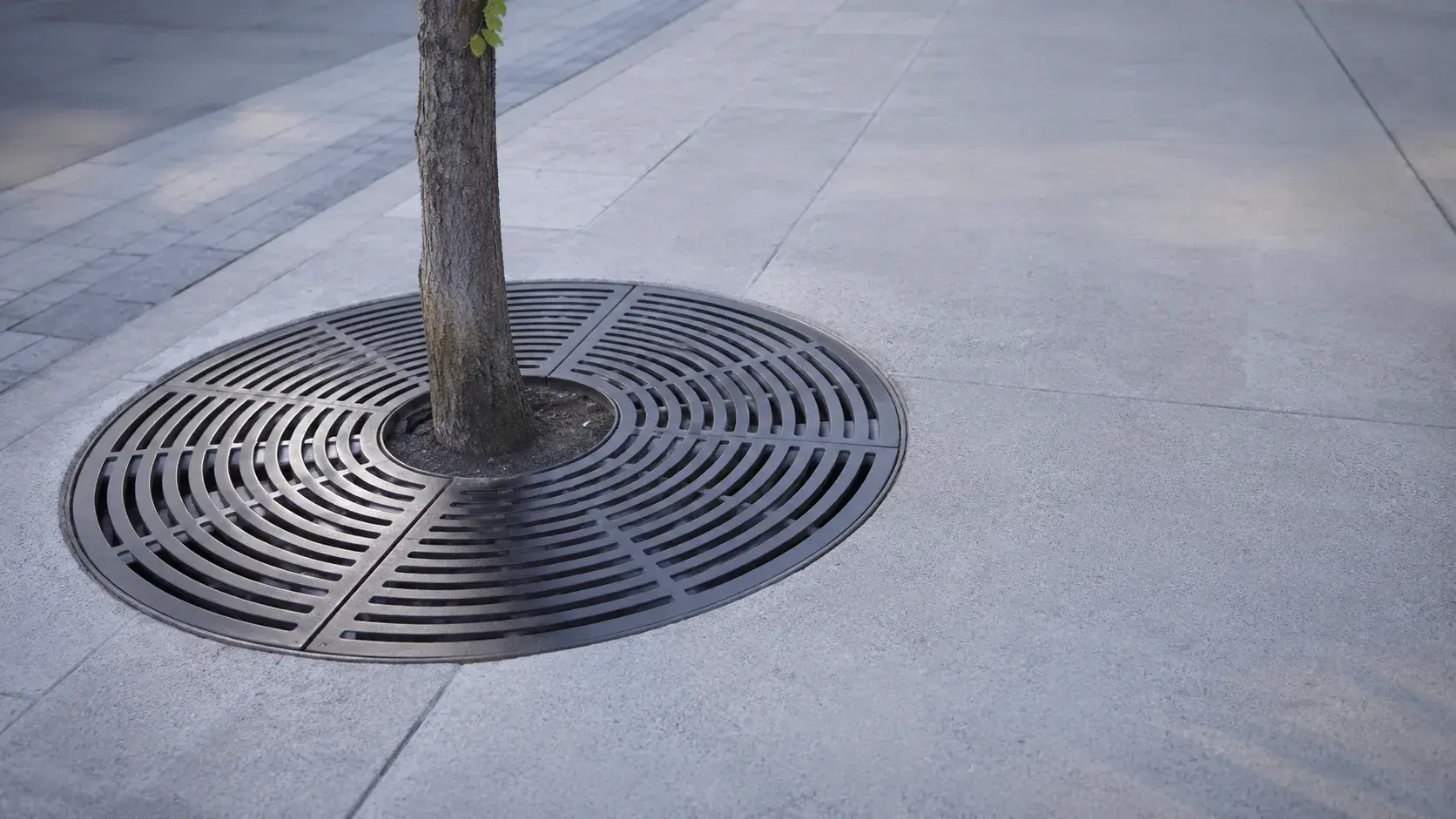
Tree Grates for Streetscapes and Plazas
A practical guide to specifying architectural tree grates for streetscapes and plazas: ADA heel-proof openings, expandable rings, load class, finishes and anchoring.
A tree grate is one of the most punished pieces of metal in the public realm. It sits flush in a sidewalk or plaza, absorbs foot traffic all day, takes the occasional delivery truck wheel, fills with grit and salt, and is expected to look intentional for decades while a living tree pushes against it from below. Get the specification right and a tree grate disappears into a well-designed streetscape.
Get it wrong and you create a trip hazard, a heel trap, a dead tree, or a casting that cracks the first winter. This guide walks through how landscape architects, municipal engineers and general contractors should think about architectural tree grates so the detail performs as well as it looks.
What a Tree Grate Has to Do in the Public Realm
Before pattern and finish, a streetscape tree grate has three jobs. It has to keep the pit surface trafficable and ADA-compliant, it has to let water and air reach the root zone, and it has to accommodate trunk growth without strangling the tree. Those goals pull against each other, which is why specifying off a catalogue thumbnail rarely produces a good outcome.
The right answer depends on pedestrian volume, whether vehicles ever cross the pit, the tree species and expected caliper, and how the surrounding paving is detailed. Tree grates belong to a broader family of site furnishings and architectural metalwork, and they should be coordinated with the same care you give benches, bollards and railings.
Heel-proof, ADA and Bicycle-safe Openings
Opening size is where most specifications succeed or fail. Slots wide enough to look elegant can swallow a narrow heel, a cane tip or a road-bike tyre. For accessible, heel-proof performance the openings around the walking surface should be kept small enough that a heel or cane cannot drop in and twist, while still passing water and leaf litter. In bike-adjacent locations, openings oriented across the direction of travel reduce the chance of a wheel dropping in.
Pattern geometry is not just decoration here, it is a safety and accessibility decision, and it is one we resolve at the drawing stage rather than on site.
Expandable Inner Rings for Tree Growth
A trunk that is 100 mm at planting can triple in caliper. If the inner opening is fixed, the casting eventually girdles the trunk and either kills the tree or gets shoved out of plane. The standard solution is a series of knock-out or removable inner rings so crews can enlarge the trunk opening progressively as the tree matures, without lifting the whole grate.
We size and detail those rings to the species and growth expectation you give us, so the maintenance crew has a clear, repeatable sequence years down the road.
Choosing the Right Load Class
Streetscape grates fail prematurely when they are specified for the wrong load. A grate in a pedestrian-only plaza is a different product from one set in a sidewalk that a service vehicle or sweeper rides over twice a week. The honest questions are: who walks on it, what crosses it occasionally, and what crosses it routinely.
A pedestrian plaza grate can be lighter and more open; anything that sees vehicle wheels, even occasionally, needs to be engineered as a load-bearing assembly with a frame to match. If you are unsure where your application sits, our grate load class guide lays out the categories in plain language, and our blog post on grate load classes explained walks through how loading translates into bar size and spacing.
For genuinely vehicular conditions, look at how we approach heavy-duty grates, because the same engineering logic applies once wheel loads enter the picture.
Frames, Anchoring and the Detail Around the Pit
The grate is only half the assembly. A tree grate that rocks, sits proud, or settles below the paving becomes a trip hazard no matter how well the panel itself is made. The frame carries the load into the surrounding structure and sets the panel flush with the finished surface, so it needs to be coordinated with your paving build-up, edge restraint and the tree pit structure.
We detail frames with positive anchoring and clear setting dimensions so the installer is not improvising tolerances in the field. This is exactly the kind of interface where supply-and-install, or at least a clear shop drawing handed to the GC, prevents the most common public-realm callbacks. The same discipline carries across our drainage work, where frame-to-cover fit determines whether a catch basin grate or trench drain grate stays quiet and level for years rather than rattling loose.
We Work From Drawings, and We Produce Them
Tree grates live at the intersection of landscape, civil and structural detailing, so they cannot be ordered blind. Every grate and fabrication we build is backed by full shop drawings, and where the assembly carries load or ties into structure we produce the structural drawings to support it.
We are comfortable starting from a landscape architect's pattern intent or an engineer's loading and tolerance requirements, then turning that into a buildable, dimensioned package you can stamp into your set and hand to the contractor. That collaboration is the whole point: you keep design control, we make sure the steel actually resolves.
We build directly with engineers on load and connection detailing, and with architects on pattern, sightlines and finish, so the drawing that leaves our shop matches the one in your specification.
Custom Patterns, Finishes and Durability
This is where a streetscape grate earns its keep visually. Because we fabricate in-shop rather than reselling stock castings, the pattern is genuinely yours: radial, linear, custom perforation, a motif tied to the public space, or a clean grid that recedes. The same shop that produces our architectural metal screens and custom metal fabrication can carry a single design language from facade screen to tree grate across a plaza.
Finish is a durability decision before it is an aesthetic one. In a salted, freeze-thaw Canadian streetscape, the finish is what stands between your steel and corrosion. Hot-dip galvanizing is the workhorse for exterior longevity; stainless reads cleaner and resists staining where appearance is paramount; powder coat over a galvanized base gives you colour control with protection underneath.
Each has trade-offs in cost, repairability and how it weathers, and the wrong choice shows up as rust streaks on the paving within a couple of seasons. Our metal and finish guide compares the options for exterior service, and our post on galvanized vs stainless vs powder-coated grates goes deeper on how each behaves over time. If slip resistance is a concern in a high-traffic pedestrian zone, we can incorporate anti-slip treatment into the walking surface.
Specifying With Confidence
A good streetscape tree grate is a coordinated assembly, not a part number: openings sized for heels, canes and bikes; inner rings that grow with the tree; a load class that matches real traffic; a frame detailed to your paving; and a finish chosen for your climate. Bring us the design intent and the loading, and we will resolve the rest in shop and structural drawings before anything is cut.
We supply across Canada, supply-only or supply-and-install, and we are glad to start from a single pit detail or a full plaza package. Explore more of our custom metal grates or head to the tree grates page to see how we approach the public realm, and visit our homepage for the full range.
Have a streetscape or plaza detail to resolve? Send us your pattern intent, loading and pit dimensions, and we will turn it into a buildable, fully drawn tree grate package. Contact The Grate Guys or see our tree grates capabilities.
Get a quote for your project
Send sizes, quantities, and your deadline. We review it and reply with the next step.