
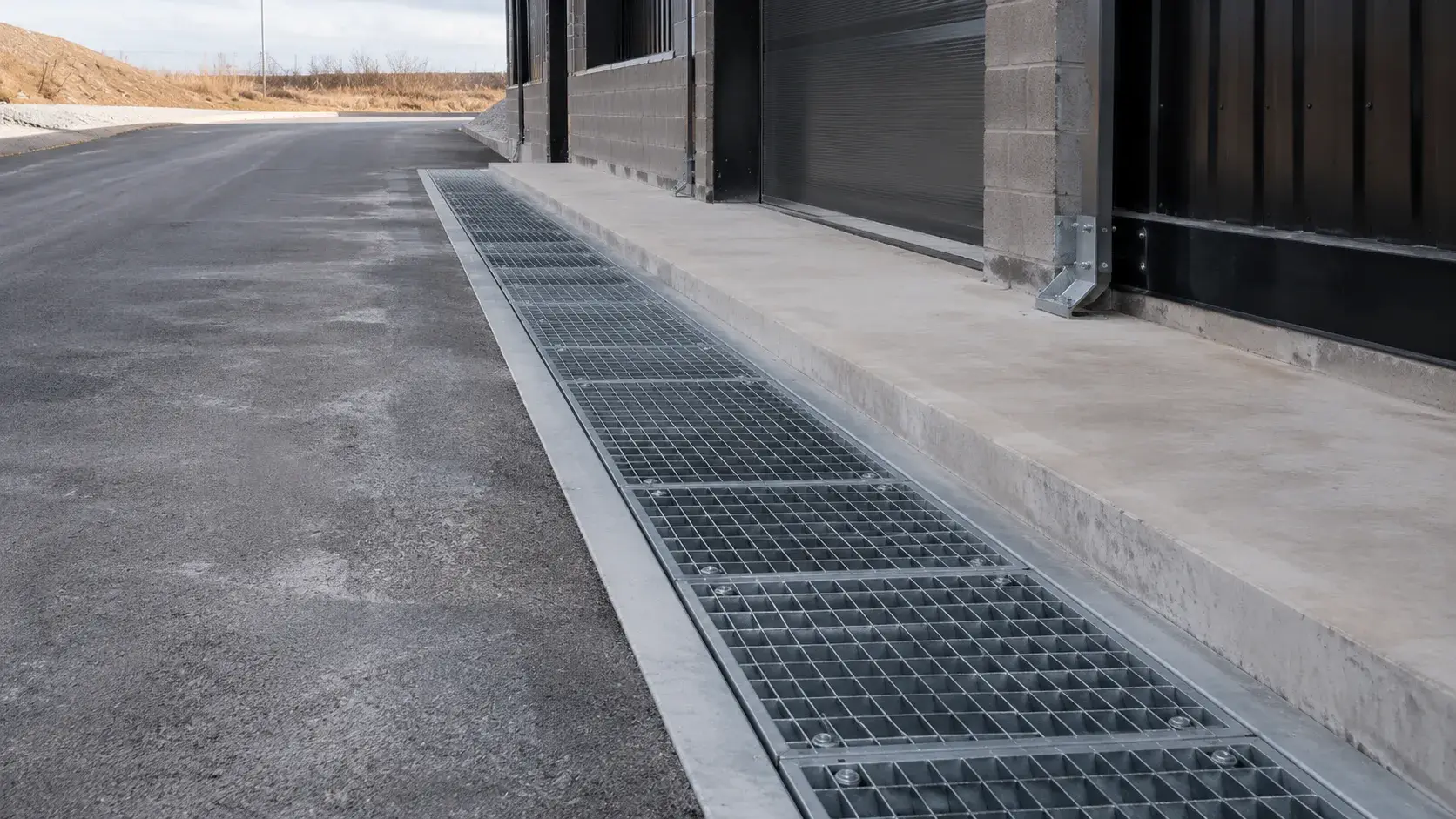
Driveway Grate Load Ratings: What Gauge and Bar Size You Need
How to choose the right load rating and bar size for a driveway grate: matching the grate to real vehicle wheel loads, span, and finish so it does not deflect, rattle, or fail.
A residential or light commercial driveway grate should be rated for the heaviest vehicle that will ever cross it, which for most driveways means a passenger vehicle or light truck, and for shared or commercial driveways can mean fire trucks and delivery vehicles. The right build is set by wheel load and span, not by a single "gauge" number. Bar grating for vehicle traffic typically uses bearing bars around 1 inch to 1-1/2 inches deep rather than a thin sheet, and the deeper the bar and the shorter the unsupported span, the more load it carries without deflecting.
People often ask "what gauge steel do I need for a driveway grate," but gauge (sheet thickness) is the wrong measure for grating. Load capacity comes from the bearing bar depth and thickness, the bar spacing, the span between supports, and the frame. This guide explains how to spec a driveway grate that carries real vehicle loads without rattling, sagging, or cracking, in Ontario conditions.
Why "gauge" is the wrong question for a driveway grate
Gauge describes the thickness of flat sheet metal. A driveway grate is not a flat sheet; it is a set of steel bearing bars standing on edge, tied together with cross bars. The strength that stops a grate from bending under a wheel comes from how deep those bearing bars are, not from any sheet gauge. A grate made from deep bars carries far more than one made from shallow bars of the same weight of steel.
So the real questions are: how deep and thick are the bearing bars, how closely are they spaced, and how far do they span between the frame or supports. Answer those and you have the load capacity.
Start with the real vehicle load
Load rating always starts with the heaviest wheel that will cross the grate, not the vehicle's total weight. What matters is how much load lands on the small contact patch of one wheel or tire.
- Passenger vehicles and light SUVs: A typical private driveway grate. Wheel loads are modest, so a properly built light-vehicular grate handles them.
- Light trucks and delivery vans: Heavier wheel loads. Common on multi-unit and commercial driveways.
- Fire trucks and garbage trucks: Many shared and commercial driveways must be rated for emergency and service vehicles, which impose large wheel and outrigger loads. This is often the governing case even if it rarely happens.
- Forklifts and heavy equipment: Yard and industrial driveways. Concentrated wheel loads that demand heavy-duty grating. See our heavy-duty grating guide.
Be honest about the worst case. A grate sized for a car will not survive a fire truck outrigger, and finding that out during an inspection or an incident is expensive. When in doubt, ask what the property, its access requirements, or the authority having jurisdiction demand.
Bar size, spacing, and span
Once you know the wheel load, three build variables set whether the grate carries it safely:
Bearing bar depth and thickness
The bearing bars are the load-carrying members. Deeper bars resist bending dramatically better. For vehicle traffic, bearing bars commonly run from about 1 inch up to 1-1/2 inches or more in depth, with thickness chosen to match the load. Shallow bars that are fine for a pedestrian walkway will visibly deflect and eventually fatigue under a car.
Bar spacing and open area
Bearing bars sit at a set spacing. Closer spacing means more bars sharing each wheel load and smaller openings, which is safer for tires, bicycle wheels, and heels but reduces open area for flow and debris. Wider spacing drains and passes debris better but puts more load on each bar and creates larger gaps. Driveway grates have to balance load, drainage, and opening safety.
Span between supports
The unsupported distance the grate bridges, from one frame edge or bearing to the next, is the biggest lever after bar depth. A grate that spans a narrow trench carries far more than the same grate bridging a wide opening. If your opening is wide, you either go to a deeper, heavier bar or add intermediate supports. Deflection, not just breakage, is the usual limit: a grate that bounces or dishes under a wheel loosens frames and cracks surrounding concrete over time.
Frame, anchorage, and finish
The grate is only as good as what it sits in. A vehicular grate needs a matching frame anchored into the concrete so the grate cannot lift, shift, or rattle under traffic. Locking devices or a captured design keep the grate seated where vehicles could otherwise flip or dislodge it.
For finish, exterior Ontario driveways face rain, freeze-thaw, and road salt. Hot-dip galvanizing is the standard, durable choice and is why most driveway and drainage grates are galvanized. Bare steel will rust quickly in this service, and paint alone does not hold up to tires and salt. See our grate finishes guide for the trade-offs.
Common mistakes that lead to failed driveway grates
- Speccing by weight or "gauge" instead of load class: Leads to grates that look solid but deflect under real wheels.
- Ignoring the fire truck or service vehicle case: The rare heavy vehicle is often the governing load on shared and commercial driveways.
- Spanning too wide with a light bar: The single most common cause of a bouncing, cracking grate.
- Reusing a bent or corroded frame: A good grate in a bad frame still rattles and works loose.
- Skipping galvanizing: Bare or painted steel rusts fast in salted, wet Ontario conditions.
What to give a fabricator
To get a driveway grate built right the first time, provide the opening dimensions (width, length, and the depth it seats into), the heaviest vehicle that will cross it, whether emergency or service vehicles must be accommodated, any opening-safety requirement such as bicycle-safe slots, and the finish. A fabricator can then size the bar, spacing, and frame to carry the load with acceptable deflection. Explore our driveway grates and custom metal grates pages for the range we build.
Frequently asked questions
What gauge steel is a driveway grate made from?
Gauge is the wrong measure for a grate. Load capacity comes from the depth and thickness of the steel bearing bars, their spacing, and the span, not from a sheet gauge. Vehicle-rated grates typically use bearing bars around 1 inch to 1-1/2 inches deep rather than thin sheet, sized to the actual wheel load.
Does my driveway grate need to be rated for a fire truck?
It depends on the driveway. Many shared, multi-unit, and commercial driveways must accommodate emergency and service vehicles, which impose large wheel and outrigger loads and often become the governing design case. A private single-family driveway usually only needs to carry passenger vehicles. Check the access requirements and the authority having jurisdiction if you are unsure.
Why does my existing grate rattle or bounce under cars?
Usually the bearing bars are too shallow for the span, or the grate is not properly seated and anchored in its frame. Both let the grate flex under a wheel, which loosens the frame and can crack the surrounding concrete. The fix is a grate with deeper bars matched to the span, seated in a sound, anchored frame.
Should a driveway grate be galvanized?
Yes, for exterior Ontario driveways. Hot-dip galvanizing resists the rain, freeze-thaw, and road salt that would quickly rust bare steel and defeat paint. It is the standard, long-life finish for driveway and drainage grates.
Need a driveway grate sized to carry your real vehicle loads? Contact The Grate Guys for a quote. We are a licensed, insured, and WSIB covered metal fabrication shop in Toronto serving contractors, property managers, developers, and facility managers across the GTA and Ontario.
Get a quote for your project
Send sizes, quantities, and your deadline. We review it and reply with the next step.