
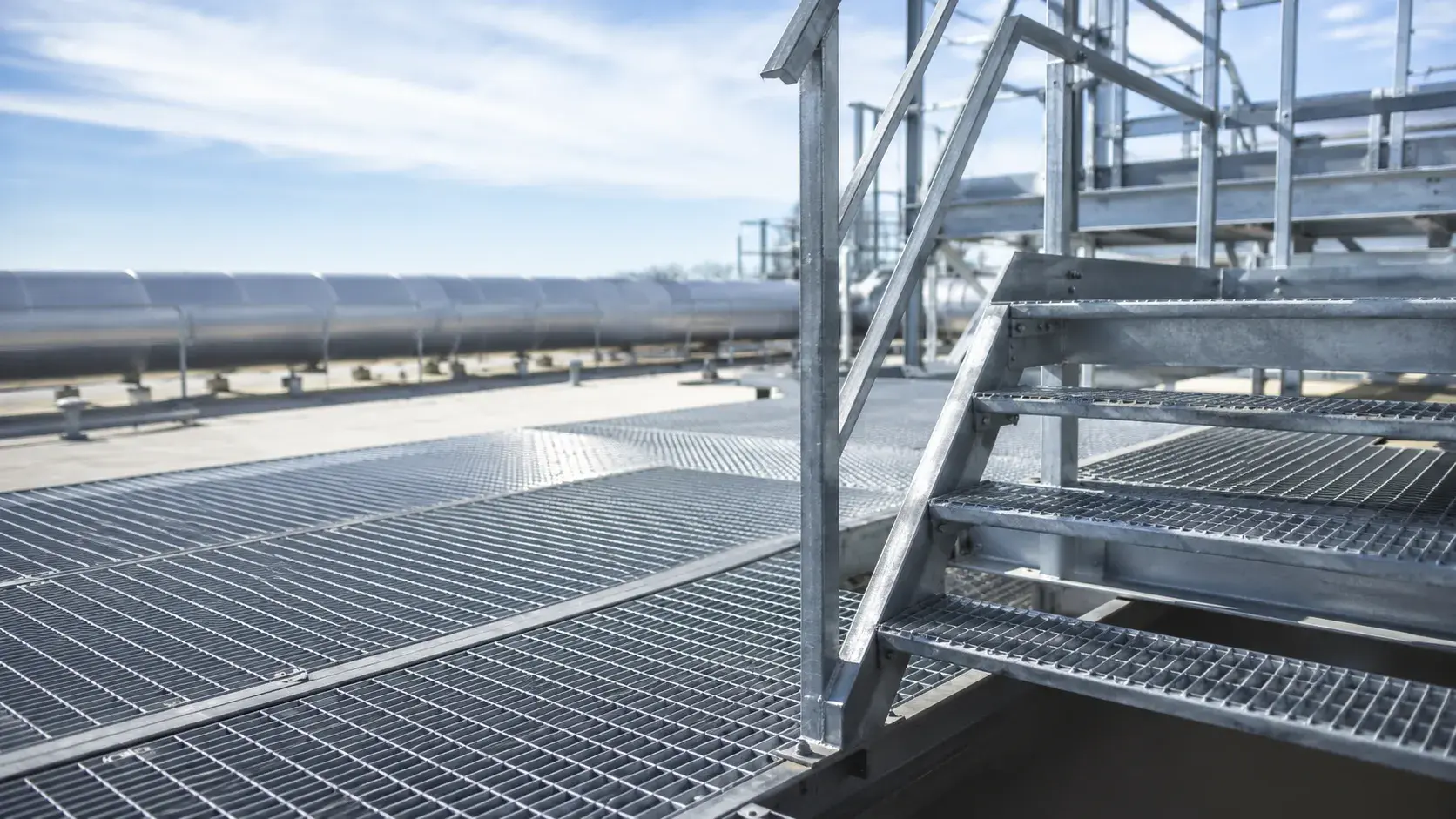
Grate Finishes: Powder Coat, Electropolish, and Hot-Dip Galvanizing
A guide to metal grate finishes: hot-dip galvanizing, powder coat, electropolishing, and bare steel, with cost, corrosion protection, and where each one fits.
Choosing a grate finish comes down to three questions: what is the environment (indoor, outdoor, wet, chemical, or food-grade), what is the base metal (carbon steel, aluminum, or stainless), and what is the budget over the full service life. For most outdoor and wet carbon-steel applications, hot-dip galvanizing gives the best corrosion protection per dollar. For stainless grates in sanitary or wash-down settings, electropolishing plus passivation is the standard. Powder coat is for appearance and colour on indoor or lightly exposed parts.
At The Grate Guys, we fabricate and finish custom metal grates for contractors, facility managers, municipalities, and industrial clients across the GTA and Ontario. Below is how we think about each finish, what it costs, and where it belongs.
Hot-Dip Galvanizing: The Workhorse for Outdoor and Wet Steel
Hot-dip galvanizing (HDG) means dipping a fabricated steel grate into a bath of molten zinc at roughly 450 degrees Celsius. The zinc metallurgically bonds to the steel and forms a series of zinc-iron alloy layers topped by pure zinc. This is not paint sitting on the surface. It is a coating that is part of the steel, which is why it holds up to abrasion, impact, and traffic far better than anything sprayed on.
The zinc protects the steel in two ways. First, it is a physical barrier. Second, and more important, it is sacrificial: zinc is more reactive than iron, so if the coating is scratched down to bare steel, the surrounding zinc corrodes first and protects the exposed steel. That galvanic protection is why a scratched galvanized grate does not immediately rust at the scratch the way painted steel does.
Longevity is the headline. In a typical GTA environment, a properly galvanized grate can last 50 years or more before first maintenance, depending on coating thickness and exposure. Industrial and coastal atmospheres shorten that, but even in aggressive settings HDG usually outlasts every other economical option. This is the default finish for outdoor bar grating, walkways, platforms, and trench drain grates that see rain, snow, salt, and standing water.
The trade-offs are appearance and colour. Galvanizing has a spangled, matte-grey look that weathers to a duller grey over time. You do not get colour choice, and the surface texture is not uniform. For most industrial and municipal work that does not matter. When it does, galvanizing can be top-coated with powder or paint (a system called duplex coating) to add colour while keeping the zinc underneath.
Powder Coat: Colour and Appearance, Not Heavy Corrosion Duty
Powder coating applies a dry polymer powder electrostatically, then bakes it so it flows into a hard, even film. It gives a clean, uniform finish in almost any colour and gloss level, which is why it is popular for architectural grates, decorative metal grates, and anything visible to the public where appearance matters.
Powder coat is tougher and more chip-resistant than wet paint, and it is more environmentally friendly to apply. But it is fundamentally a barrier coating with no sacrificial protection. Once the film is chipped, cracked, or worn through to bare steel, moisture gets under it and rust spreads beneath the coating, often unseen until it lifts the film. Grates take abuse, so on a walking or driving surface powder coat will eventually chip at edges and high-wear points.
The right way to use powder on carbon steel outdoors is over a galvanized base. That duplex system gives you the colour of powder plus the long-term protection of zinc, and the two together last longer than the sum of their parts. Powder coat alone is best kept to indoor, dry, or low-abrasion applications, or to aluminum and stainless where the base metal already resists corrosion.
Electropolishing: For Stainless in Sanitary and Wash-Down Settings
Electropolishing is an electrochemical process used on stainless steel. The grate is submerged in an electrolyte and current is run through it, removing a thin, controlled layer of surface metal. It preferentially strips the microscopic peaks, leaving a smoother, brighter, and cleaner surface than mechanical polishing can achieve.
That smoothness matters most in food and beverage, pharmaceutical, cleanroom, and wash-down environments. A smoother surface has fewer crevices for bacteria, product residue, and contaminants to lodge in, and it is far easier to clean and sanitize. Electropolishing also removes surface iron and other contaminants, which improves corrosion resistance and gives the bright, hygienic look expected in sanitary facilities.
Electropolishing is only for stainless (and a few other alloys), it is a premium process, and it does nothing for carbon steel. If you are speccing stainless grating, the choice of alloy also matters as much as the finish. Our guide on 304 vs 316 stainless grates covers when the extra corrosion resistance of 316 is worth it.
Passivation: The Quiet Step That Protects Stainless
Passivation is often confused with electropolishing, but it is a different, complementary step. It uses an acid treatment (typically nitric or citric) to remove free iron and other contaminants left on a stainless surface from fabrication, cutting, or handling. Removing that free iron lets the chromium in the stainless form its natural, self-healing passive oxide layer, which is what makes stainless resist corrosion in the first place.
Passivation does not change the appearance the way electropolishing does. It is a chemical clean-and-restore step. Best practice on fabricated stainless grating is to passivate after welding and machining, and to electropolish as well when a sanitary or bright finish is required. Skipping passivation is a common reason stainless grates develop rust spots that owners did not expect from a stainless part.
Bare and Mill Steel: Lowest Cost, Shortest Life
Bare or mill-finish carbon steel has no protective coating at all. It is the cheapest option up front and is fine for temporary work, fully dry indoor areas, or grates that will be painted or coated later. Left exposed to any moisture it will rust, so it is a poor choice for anything permanent, outdoor, or wet.
Sometimes bare steel is specified because the customer plans to weld or modify the grate on site and coat it afterward, or because it lives in a controlled dry environment where corrosion is not a concern. Outside of those cases, the small up-front saving is usually erased by early replacement.
Finish Comparison at a Glance
| Finish | Base metal | Corrosion resistance | Relative cost | Typical use |
|---|---|---|---|---|
| Hot-dip galvanizing | Carbon steel | Excellent (sacrificial zinc) | Low to moderate | Outdoor, wet, industrial, municipal walkways and drains |
| Powder coat | Steel, aluminum, stainless | Moderate (barrier only, chips) | Moderate | Indoor, architectural, colour-critical, low abrasion |
| Duplex (galvanize + powder) | Carbon steel | Very good (zinc plus colour) | Higher | Outdoor grates needing colour and long life |
| Electropolish + passivate | Stainless | Excellent | Premium | Food, pharma, cleanroom, wash-down, sanitary |
| Passivation only | Stainless | Good to excellent | Low add-on | Any fabricated stainless grate after welding |
| Bare / mill steel | Carbon steel | Poor | Lowest | Temporary, dry indoor, or coat-later |
How the Environment Drives the Choice
The single biggest factor is where the grate will live. A finish that is perfect indoors can fail in a year outside, and a premium sanitary finish is wasted money in a dry mechanical room.
- Indoor and dry: Powder-coated steel or aluminum works well and looks clean. Bare steel is acceptable if appearance and corrosion are not concerns.
- Outdoor and wet (rain, snow, road salt): Hot-dip galvanizing is the default. Add powder over the galvanizing (duplex) if colour is required.
- Coastal or heavy chloride: Galvanizing works but ages faster, so specify a heavier coating or step up to 316 stainless. Chlorides are hard on ordinary stainless, which is why 316 matters here.
- Chemical exposure: Match the material and finish to the specific chemistry. Stainless with the right alloy, or specialty coatings, rather than a general-purpose finish.
- Food-grade and wash-down: Stainless, passivated, and usually electropolished for cleanability and hygiene.
We ship finished steel across the country as well as locally. Our note on galvanized steel fabrication shipped across Canada covers how we protect coatings in transit so parts arrive ready to install.
Maintenance and Touch-Up
No finish is truly zero-maintenance, but they age differently. Galvanizing needs almost nothing for decades; if the coating is damaged during installation or by a heavy impact, a zinc-rich cold galvanizing compound restores the sacrificial protection at the damaged spot. Do not touch up bare galvanizing with ordinary paint and expect the same performance, because paint has no galvanic action.
Powder coat should be inspected periodically at edges and high-traffic points where chipping starts. Repair chips promptly, before moisture creeps under the film, using a matched touch-up. On stainless, keep surfaces clean; if rust spots (usually from embedded carbon-steel particles) appear, a re-passivation removes the contamination and restores the passive layer. A simple rule: the harsher the environment, the more often you inspect, regardless of finish.
Frequently Asked Questions
What is the best all-around finish for outdoor steel grates?
Hot-dip galvanizing. It gives excellent corrosion protection through sacrificial zinc, holds up to traffic and impact, and typically lasts decades outdoors in the GTA with little maintenance. Add a powder top-coat if you also need colour.
Why does my powder-coated grate rust even though it is coated?
Powder coat is a barrier with no sacrificial protection. Once it chips or wears through to bare steel, moisture gets underneath and rust spreads below the film. On carbon steel outdoors, powder should go over a galvanized base, not directly on steel.
Do stainless grates need any finishing?
Yes. Fabricated stainless should at least be passivated after welding to remove free iron and let the protective chromium oxide layer form. For sanitary, cleanroom, or wash-down use, add electropolishing for a smoother, more hygienic, easier-to-clean surface.
Is galvanizing or stainless better for a coastal or chemical environment?
It depends on exposure. Galvanizing performs well but ages faster in chloride-heavy coastal air. For persistent chloride or chemical contact, 316 stainless, passivated and often electropolished, is usually the more durable long-term choice.
Talk to Us About the Right Finish
The best finish is the one matched to your material, environment, and service life, not a default. If you tell us where the grate will live and what it has to stand up to, we will spec the base metal and finish that lasts. Contact The Grate Guys for a quote on custom fabricated and finished grating across the GTA and Ontario.
Get a quote for your project
Send sizes, quantities, and your deadline. We review it and reply with the next step.