
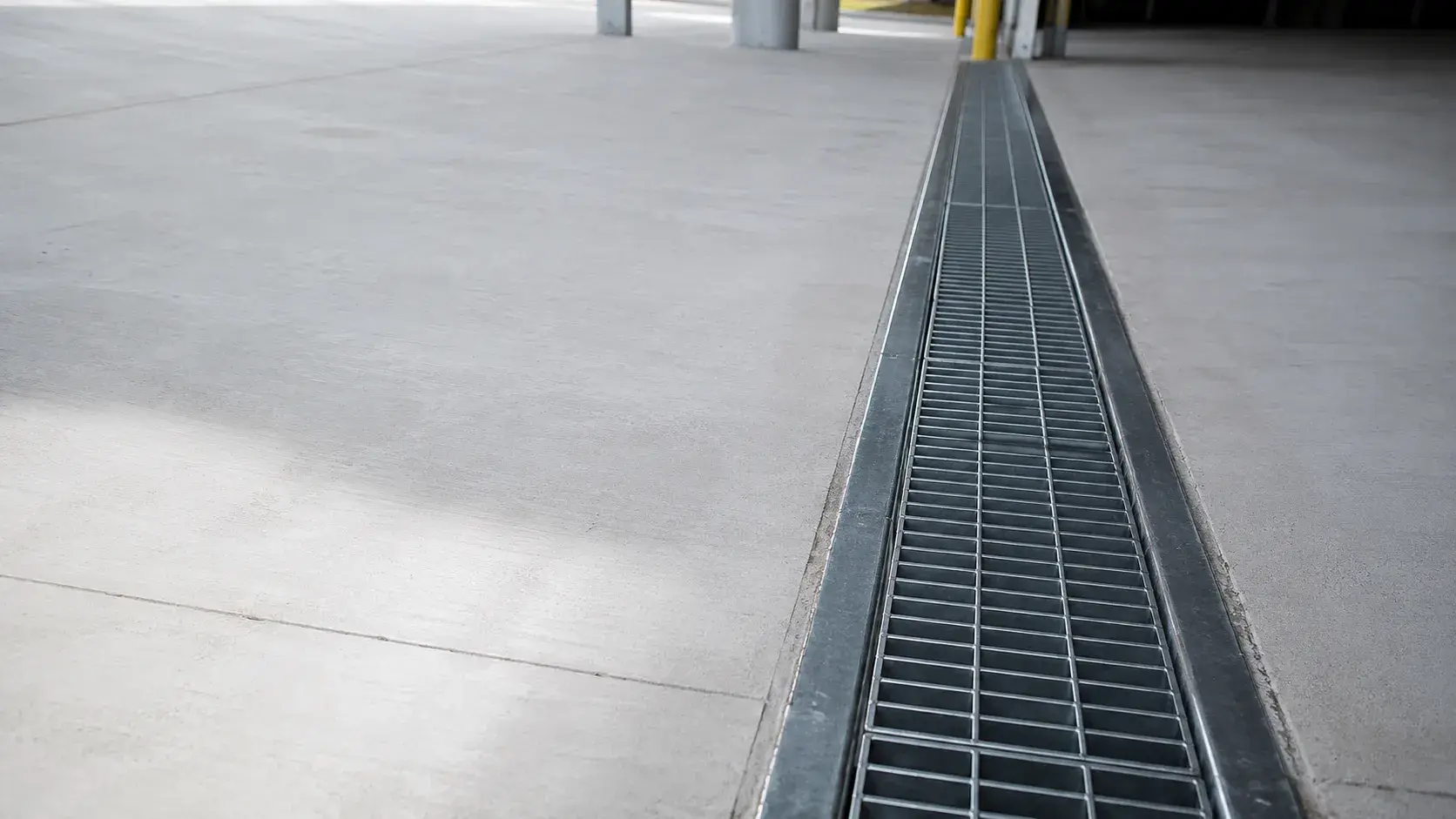
Trench Drain Grates for Loading Docks and Wash Bays
How to size, load-rate, and select trench drain grates for loading docks, wash bays, food plants and parking structures, plus frame anchoring and replacement.
Walk any busy loading dock at the end of a shift and you'll find the same failure points: a drainage grate bowed under a forklift wheel, a cracked weld at the frame, or a slot pattern so coarse a heel or a pallet jack castor drops straight in.
A trench drain grate is the one component that takes the full punishment of traffic, water, chemicals and debris every single day, and it's almost always the part that gets specified last and fails first. This guide walks engineers, GCs, specifiers and facility managers through sizing the channel, picking the right load class, choosing the correct slot geometry, and detailing the frame so the system actually lasts.
Start With Flow: Sizing the Channel Before the Grate
Grate selection follows hydraulics, not the other way around. Before you choose a product, you need the design flow rate for the area being drained, wash-down volume in a food plant or wash bay, peak rainfall intensity feeding an open loading dock, or the combined discharge from equipment in a process area. From there you size the channel cross-section and slope (sloped invert or a stepped/neutral channel with built-in fall), then confirm the grate's open area can pass that flow without surcharging.
A common mistake is choosing a grate with high mechanical strength but low open area, then watching water sheet across the floor during peak wash-down. The grate's intake capacity has to match the channel it sits in.
We work from your flow numbers and channel dimensions to confirm open area, bar pitch and intake, and where you're integrating with catch basin grates or area drains downstream, we detail those transitions too. For broader site drainage layouts, our drainage solutions hub covers how trench, catch basin and channel components work together.
Choosing the Right Load Class
Load class is where most loading dock drainage grates go wrong. A grate rated for foot traffic will deform under a loaded forklift; a grate rated for occasional cars will fatigue under constant container-handling equipment. The governing question isn't "what drives over it", it's "what's the heaviest wheel load, how often, and what's the dynamic factor."
| Environment | Typical traffic | Load consideration |
|---|---|---|
| Food plant / wash bay | Foot traffic, carts, pallet jacks | Light to medium duty; corrosion drives selection |
| Loading dock apron | Forklifts, pallet jacks, occasional trucks | Medium to heavy duty, high cycle count |
| Parking structure ramp | Cars, light trucks | Medium duty with deflection limits |
| Yard / heavy civil entry | Loaded trucks, container handlers | Heavy-duty grates, point-load critical |
Don't guess your way through this. Our grate load class guide breaks down the duty categories against real wheel loads, and the companion post on grate load classes explained walks through how to read them in practice. For the heaviest applications, heavy-duty grates with deeper load bars and tighter spacing are the right call.
Slot Geometry: Slotted, Bar, ADA and Heel-Proof
The grate opening pattern is a trade-off between flow, safety and what rolls across it. Get it wrong and you create either a drainage bottleneck or a trip-and-fall liability.
- Standard bar grating, maximum open area and flow, best for high-volume wash-down. The wide spacing is unsuitable where heels, small castors or thin wheels travel. See our bar grating options.
- Slotted / transverse-slot grates, narrow slots perpendicular to traffic, good for capturing sheet flow on a dock apron while supporting wheel loads.
- ADA / heel-proof grates, openings limited (commonly to ≤13 mm in the direction of travel) so heels, canes and small wheels can't drop in. Essential in pedestrian zones, entries and accessible routes.
- Anti-slip surfaces, serrated or textured tops for wet, greasy environments. Our anti-slip grating is built for wash bays and food-plant floors where standing water and oils are constant.
In food and pharma areas, a smooth, cleanable surface and corrosion resistance often outrank raw open area, which is where stainless steel floor grates and our clean room solutions come in.
Debris, Cleanout and Maintenance Access
A trench drain only works if it can be cleaned. In food plants and wash bays, organic solids, packaging fragments and grease build up fast; in parking structures and yards it's grit, leaves and sediment. Design in removable grate sections that one person can lift safely, sediment buckets or basket inserts at intervals, and clear access to the channel invert.
If your existing grates are seized, rusted into the frame, or too heavy to remove, that's a maintenance failure waiting to happen, and a good trigger for a grate replacement program. Facility teams managing this across a site will find our facility manager checklist a practical starting point.
Frame Anchoring: Where Systems Actually Fail
Most trench-drain complaints trace back to the frame, not the grate. A loose or under-anchored frame lets the grate rock under each wheel pass, which hammers the concrete edge, cracks the slab, and eventually spits the grate out. The frame has to be anchored to develop the full load path into the structure, continuous anchor legs or studs cast into the surround, proper concrete cover, and a tight, rattle-free seat for the grate.
We fabricate frames and grates as a matched system so tolerances are controlled in-shop rather than field-fitted. Where a trench ties into adjacent steel, dock edges, pit surrounds, equipment bases, we can integrate it with the surrounding structural steel fabrication and custom metal work so the whole assembly is detailed together.
Galvanized vs. Stainless: Matching Material to Environment
Material choice is driven by what's in the water. Hot-dip galvanized grates are the workhorse for loading docks, parking structures and general yard drainage, strong, economical and corrosion-resistant for typical exposure. But in food plants, wash bays, chemical areas and anywhere with frequent caustic or acidic wash-down, galvanizing gets attacked and stainless is the right specification.
Stainless also wins where hygiene and cleanability are non-negotiable. Our breakdown of galvanized vs. stainless vs. powder-coated grates and the metal and finish guide help you match the finish to the chemistry of your site.
We Produce Full Drawings for Every Grate We Build
Trench drainage lives or dies on coordination, channel slope, grate seat elevation, frame anchorage and the structural slab all have to agree. That's why every grate and frame assembly we fabricate is backed by complete structural and shop drawings, produced in direct collaboration with your design team.
We mark up load paths, bar sizing, anchor details and grate-to-frame tolerances so there are no surprises at the pour or at install. If you're an engineer setting deflection and load criteria, our engineering page shows how we work to a spec; if you're an architect coordinating finishes and accessibility, our architects page covers how we detail visible grates to design intent.
Replacing Failed Grates Without Replacing the Channel
You rarely need to demolish a working channel to fix a failing grate. In most cases we can fabricate a replacement grate, and a new frame if the original is corroded, to match the existing opening, load class and slot pattern.
The key is accurate field measurement; our guide on how to measure a replacement grate walks through capturing the dimensions and seat detail correctly the first time. For property managers and GCs running multiple sites, see how we handle this at scale on our property managers and general contractors pages.
Whether you're specifying a new system from flow calcs or swapping out grates that have already failed, the principles are the same: size for flow, rate for the real load, pick slot geometry for safety, anchor the frame properly, and match material to the environment. We fabricate all of it in-shop in Ontario and ship across Canada, supply-only or supply-and-install. If you are unsure whether you need a surface channel at all, see our comparison of French drains, channel drains and trench drains.
Ready to size or replace your trench drainage? Explore our trench drain grates or contact The Grate Guys with your channel dimensions, flow rate and load requirements, and we'll produce drawings for your review. Start at our homepage to see the full fabrication range.
Get a quote for your project
Send sizes, quantities, and your deadline. We review it and reply with the next step.