
French Drain vs Channel Drain vs Trench Drain: Which to Use
A French drain collects groundwater below grade, while channel and trench drains catch surface runoff at a grate. Here is how to choose for an Ontario lot.
A French drain is a buried, gravel-wrapped pipe that collects groundwater below grade. A channel drain, also called a trench drain, is a grated channel that catches surface runoff. If the water is in the soil, you need the first. If it is sheeting across paving, you need the second.
The confusion is understandable, because all three names describe a trench that moves water. The useful question is not "which is better" but "where is the water coming from, and where is it allowed to go?" This guide answers both, and shows where a fabricated steel grate fits into the picture. If your problem is subsurface, our French drain installation page covers that work directly.
What is the real difference between the three drains?
The difference is the water source. A French drain intercepts water moving through the ground, and a channel or trench drain intercepts water moving across the surface.
| Drain | Collects | Where it sits | What you see | Best for |
|---|---|---|---|---|
| French drain | Groundwater and saturated soil | Buried in a gravel-filled trench | Nothing, or sod over the top | Soggy lawns, retaining wall backs, low spots in soil |
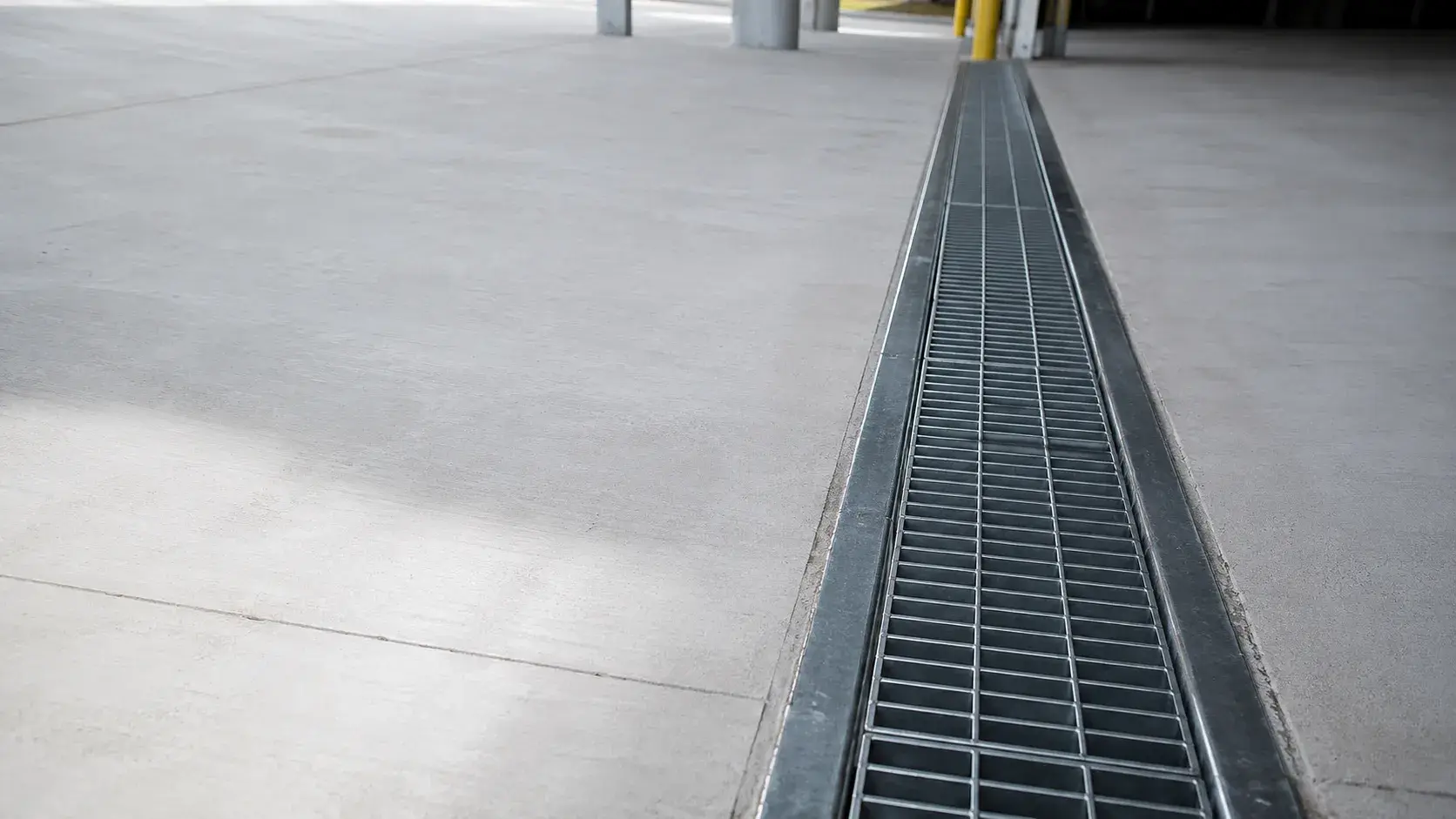
| Channel drain | Surface runoff | Flush with paving | A long grate | Driveways, patios, garage aprons, walkways |
| Trench drain | Surface runoff, often at high volume | Flush with a slab or pavement | A long grate, often rated for vehicles | Loading docks, wash bays, yards, parking areas |
Channel and trench drains are the same idea at different scales. A trench drain is usually deeper, longer, built for heavier loads and sized to a design flow. The commercial version is covered in our guide to trench drain grates for loading docks and wash bays.
When is a French drain the right answer?
A French drain is right when water rises or soaks through the ground and the surface above it is soil or lawn. Typical signs are a lawn that stays spongy days after rain, water that seeps out at the base of a slope, or a wet strip along a wall.
- The water appears even when it has not rained hard, or lingers for days.
- The ground is grass, garden or gravel, not paving.
- The area sits lower than its surroundings and the soil does not drain.
- You have somewhere lawful for the water to go at a lower elevation.
The slope matters more than the pipe. A buried drain only works if it falls toward a proper outlet along its whole length, and it only works if the outlet is not a neighbour's yard. Local conditions vary, which is why we offer French drain work as a separate service, including French drain installation in Toronto.
When is a channel or trench drain the right answer?
A channel or trench drain is right when water is running across a hard surface and needs to be caught before it reaches a door, garage or neighbour. If the problem appears during a storm and is gone soon after, it is almost always surface water.
- Rain runs down a driveway toward the garage door.
- A patio or walkway sheds water against the house wall.
- A loading dock, wash bay or yard collects water in front of a door.
- A ramp or stair landing needs a clean, level edge instead of a puddle.
The channel catches water across its full length, so it can stop water that a single catch basin would miss. Our trench drain grates are fabricated to the channel width, finish and load class you specify, and our wider drainage grates range covers the rest of a surface drainage layout.
Why does the outlet decide so much?
Every drain is only as good as its outlet, and the outlet is where most projects go wrong. Water has to end up somewhere that is permitted, lower than the drain and able to take the flow.
Toronto's lot grading requirements for infill housing say the grading plan must ensure no new ponding on adjacent properties, and cite Ontario Building Code sentence 9.14.6.1, which asks that a site be graded so water does not adversely affect adjacent properties. The same City page gives drainage swale slopes of not less than 1.5 percent along their length, which is a useful rule of thumb for any surface path. You can read it on the City's lot grading requirements for infill housing.
Connecting to the municipal sewer is a different matter. Toronto's Sewers By-law controls what may be discharged to the sewer, and the City publishes a private water discharge application tied to it. Ask your municipality before you plan a connection. Rules differ between municipalities across Ontario.
Where the water drains to a municipal catch basin, the frame and grate there have their own requirements, covered in our post on catch basin grates, load class and frames.
Which one should you choose? A quick decision path
- Stand outside during or just after a hard rain. Is water running over the surface, or is it coming up out of the ground?
- If it runs over paving, use a channel or trench drain across the low edge, with a fall toward the outlet.
- If the soil is saturated and the surface is lawn or garden, use a French drain, with a permitted outlet lower than the drain.
- If you see both, treat both: a surface drain for the paving and a buried drain for the soil beside it.
- Confirm the outlet with your municipality before work starts.
What goes wrong with each type?
Most failures are predictable. Knowing them helps you ask better questions before you hire anyone.
- French drain: silt clogs the gravel or pipe if fabric or filter material is wrong, the pipe has no fall, or the outlet is blocked or frozen in winter. Access points for cleanout help a lot.
- Channel drain: the grate is too light for the traffic, the channel is set slightly proud of the paving so it does not catch water, or leaves and grit fill the channel because nobody clears it.
- Trench drain: the channel is undersized for the flow, the frame is not anchored into the slab edge, or the grate openings are wrong for the people and wheels crossing it.
The grate is the part you can see and the part that takes the abuse. Our guide to sizing drainage grates for flow and debris explains open area and clogging, and our custom metal grates page shows what we can fabricate when a stock grate does not fit the channel.
What to have ready before calling
- Photos of the problem area taken during or right after rain.
- Whether the surface is soil, lawn, concrete, asphalt or pavers.
- Approximate length of the area and which way it slopes.
- Where you think the water could go, and whether a sewer or catch basin is nearby.
- The heaviest traffic that will cross any grate: foot, bikes, cars or trucks.
- Any drawings, survey or grading plan you already have.
Cost depends on length, depth, soil, the outlet, the grate type and the finish. We would rather give you a real number after seeing the site than a guess in a blog post.
Frequently asked questions
Is a channel drain the same as a trench drain?
Mostly. Both are a narrow channel with a grate set flush with the surface. Trench drain is the more common term on commercial jobs, and channel drain is more common on driveways and patios.
Can a channel drain fix a wet yard or damp basement?
Not by itself. It only takes water that reaches the surface. Saturated soil is a French drain problem, and a damp basement should be assessed properly first.
If your problem is groundwater, start with our French drain installation page and send us what you have.
Frequently asked questions
Is a channel drain the same as a trench drain?
In most conversations, yes. Both are a long, narrow channel set flush with the surface and covered by a grate. Trench drain is the term more common on commercial and industrial jobs, while channel drain is more common for driveways and patios. The grate, the channel and the outlet are what you specify, whatever name is used.
Can a channel drain fix a wet yard or a damp basement?
Usually not on its own. A channel drain only takes water that reaches the surface, so it will not lower groundwater beside a foundation. A wet lawn caused by saturated soil is a French drain problem, and a damp basement wall may call for exterior foundation drainage, which should be assessed before anything is dug.
Can I use a French drain under a driveway or patio?
A buried drain can run under paving, but the water has to get into it from the soil, not from the paving surface. If rain is pooling on the pavement itself, the fix is a surface drain such as a channel drain across the low edge, or regrading, not a buried pipe.
Where is the water allowed to go?
It must not be sent onto a neighbouring property. Toronto asks that sites be graded so water does not adversely affect adjacent properties, and the Sewers By-law governs what can be connected to the municipal sewer. Check your municipality before you pick an outlet, because the outlet often decides which system is allowed.
What grate do I need on a channel drain?
Match the grate to the heaviest thing that crosses it. Foot traffic, wheelchairs and heels call for narrow, heel-safe openings, while a driveway or yard needs a rated grate that carries vehicle wheel loads. Tell us the traffic, the channel width and the finish you want, and we fabricate the grate to fit.
Get a quote for your project
Send sizes, quantities, and your deadline. We review it and reply with the next step.