
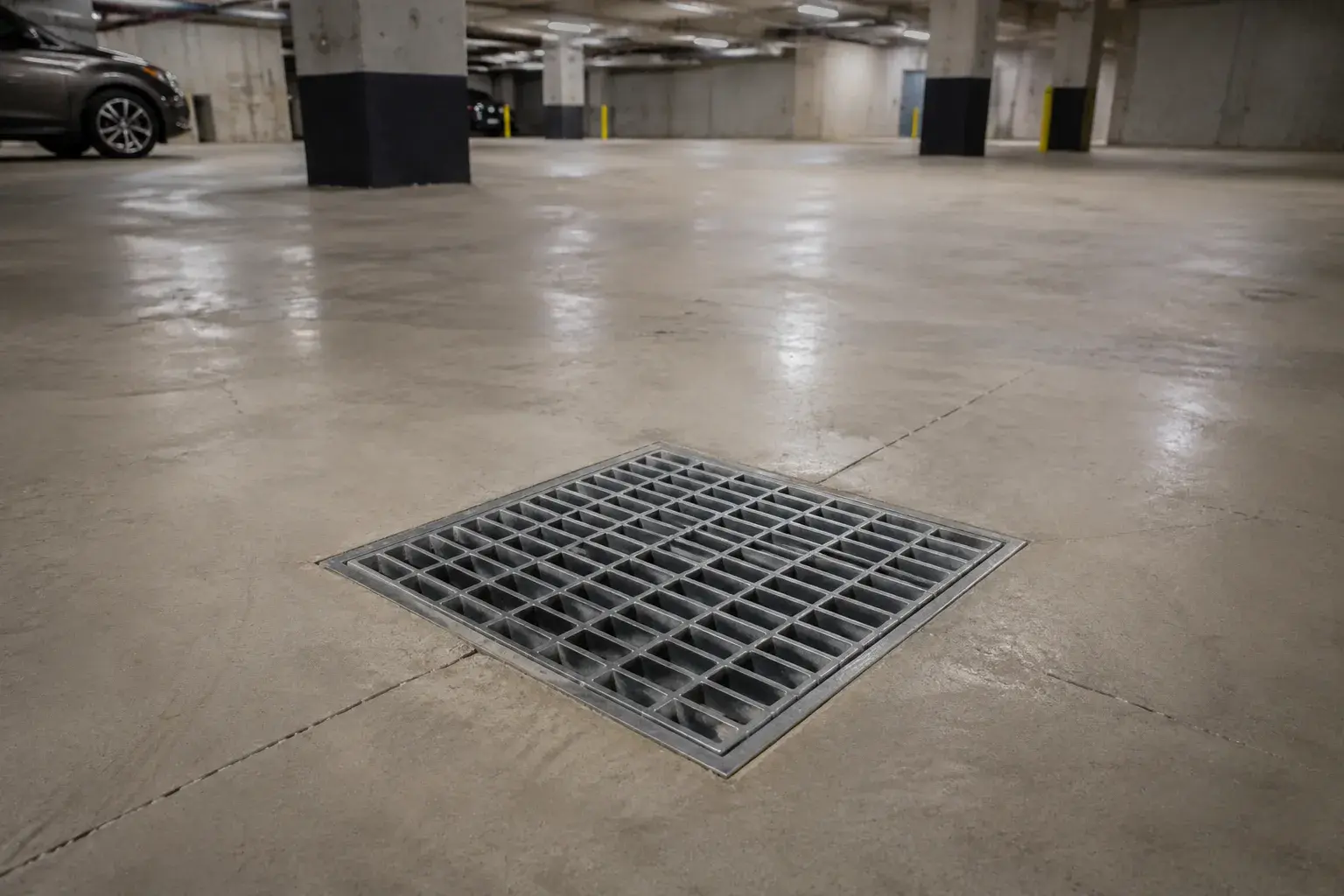
Sizing Drainage Grates for Flow and Debris
How to size drainage grates for real flow: open area and flow capacity, slot width vs debris and safety, bicycle and heel-safe openings, and matching grate to trench and load.
Sizing a drainage grate comes down to three things working together: enough open area to pass the design flow, an opening pattern that captures water without trapping debris or endangering pedestrians and cyclists, and a load class that matches the traffic overhead. The channel or catch basin sets the outer dimensions, but the open area, slot geometry, and load rating are what decide whether a grate actually drains the way the drawing intended. Get those wrong and you either flood the surface, blind the grate with leaves, or crack the frame under a forklift.
Below is how we approach grate sizing at The Grate Guys when a contractor, facility manager, or municipality hands us a drainage spec in the GTA. The hydraulic numbers here are planning-level guidance; final flow capacity should always be confirmed by the project's civil or drainage engineer.
Open area and flow capacity
Open area is the percentage of the grate surface that is actual opening rather than solid bar or plate. It is the single biggest driver of how much water a grate can accept. A grate rated at 40 percent open area passes far more flow than one at 15 percent, even if both sit on the same trench.
Flow into a grate happens two ways. In weir flow, water spills over the perimeter of the openings while depth is shallow. In orifice flow, the grate is submerged and water is drawn through the openings under head. Most surface drainage runs as weir flow at low depth and only shifts to orifice flow once ponding builds. Both regimes reward more open area and longer open perimeter.
- Open area percentage sets raw intake capacity. Slotted and reticuline patterns typically deliver more open area than heavy bar grates.
- Approach conditions matter. Sheet flow across a wide grate behaves differently than concentrated flow hitting a catch basin at a low point. A grate in a sag captures more than the same grate on a continuous slope.
- Clogging factor. Engineers commonly derate effective open area by 30 to 50 percent to account for leaves, sediment, and debris. Size for the clogged condition, not the clean lab number.
The practical takeaway: never size a grate on outside dimensions alone. A large grate with a low open area percentage can move less water than a smaller grate with an aggressive slot pattern. See our drainage grates overview for the pattern options we fabricate.
Slot and opening width vs debris capture and safety
Opening width is a tug of war. Wider openings pass more water and shed debris better, but they create trip, heel, and bicycle-tire hazards. Narrower openings are safer for pedestrians but clog faster and cut flow. The right answer depends entirely on who and what travels over the grate.
Heel-safe openings
In pedestrian zones, plazas, transit platforms, and building entrances, openings should be narrow enough that a shoe heel cannot drop in. A common heel-safe target keeps slot widths at or below roughly 13 millimetres (about half an inch) in the direction a heel would enter. Cross-slotted or diamond patterns help by shortening the unbroken slot length.
Bicycle-safe openings
Anywhere cyclists cross a grate, bars must run transverse to travel or the pattern must be cross-barred so a tire cannot drop into a slot parallel to the wheel. Long slots aligned with the direction of travel are the classic bicycle hazard and should be avoided on any bike route, shared path, or urban street. This is a genuine liability issue for municipalities, not just a comfort item.
- Pedestrian and barefoot areas (pools, splash pads): tight openings, heel-safe, ADA and accessibility compliant.
- Bike lanes and shared streets: transverse or cross-barred, never parallel slots.
- Loading docks and yards: wider slots acceptable, prioritize debris shedding and flow.
- Landscape and roof drains: balance flow against leaf load; a debris hood or sediment bucket often beats simply widening slots.
Matching the grate to the trench or channel width
A grate has to seat correctly in its frame or channel, or none of the flow numbers matter. The clear opening of the trench, the frame rebate, and the bearing bar spacing all have to line up. On a trench drain grate the grate typically sits in a formed channel or a bolt-down frame, and the bearing surface on each side must be adequate to carry the load into the surround.
- Nominal vs clear width. A "6 inch" trench is a nominal size; the actual grate width accounts for the frame ledge on both sides. Always fabricate to the real measured opening.
- Bearing edge. Enough grate must rest on each side to transfer wheel loads without rocking or point-loading the concrete.
- Locking and lift resistance. In traffic or flood-prone areas, bolt-down or lockdown grates stop uplift and theft. Vehicular sites usually require positive locking.
- Length and modularity. Long runs are broken into removable sections for cleaning and to keep individual pieces liftable by hand.
For point drainage, the same logic applies to a catch basin grate: the grate must match the basin frame's bolt pattern and bearing surface, and its capacity in a sag is often the governing hydraulic case for the whole system.
Load class vs open area trade-off
Every grate carries a load rating tied to where it lives, from light pedestrian duty up to heavy vehicular and airport or port loading. Higher load classes generally demand thicker, deeper bearing bars set at closer spacing, and that directly eats into open area. A grate that survives a loaded truck axle will almost always have less open area than a pedestrian grate of the same footprint.
This is the core trade-off in grate sizing: you cannot maximize load capacity and open area at once in the same footprint. Options when both matter:
- Go deeper, not just narrower. Deeper bearing bars add strength while keeping slots reasonably open.
- Increase the grate footprint. A longer or wider grate recovers open area lost to close bar spacing.
- Choose the right material and profile. Higher-strength steel or an engineered bar profile can hold a load class at a more open pattern.
| Opening type | Flow / open area | Debris shedding | Pedestrian and bike safety |
|---|---|---|---|
| Wide longitudinal slots (parallel to travel) | High | Excellent | Poor (heel and bicycle hazard) |
| Transverse bar / cross slots | Medium to high | Good | Good (bicycle-safe) |
| Narrow heel-safe slots | Medium | Fair (clogs faster) | Excellent (heel-safe) |
| Perforated / small round holes | Low to medium | Poor (blinds easily) | Excellent |
| Reticuline / diamond mesh | High | Good | Good |
Materials for wash-down and corrosive settings
Material choice affects both service life and, indirectly, sizing, because a corroded grate loses open area as bars pit and scale. Match the metal to the environment:
- Galvanized steel: the workhorse for most exterior drainage, roadways, and yards. Cost-effective with solid corrosion resistance.
- Stainless steel (304 or 316): for food processing, breweries, commercial kitchens, and wash-down areas where hygiene and chemical exposure matter. 316 for chloride and coastal or de-icing salt exposure.
- Aluminum: light, corrosion resistant, and easy to lift for frequent cleaning, best in lighter-duty or architectural applications.
- Coated or FRP-style profiles: for aggressive chemical environments where steel struggles.
Wash-down environments add their own requirement: smooth, slot-forward geometry that rinses clean and does not trap product or bacteria. We fabricate to those specs as part of our custom metal grates work.
Maintenance and access
A drainage grate is only as good as its worst-maintained day. Design for cleaning from the start:
- Removable sections sized to be lifted safely by one or two workers.
- Lifting features such as slots or hook points so grates come up without prying and damaging the frame.
- Sediment buckets or baskets in catch basins to catch debris before it enters the pipe.
- Locking hardware that a maintenance crew can actually open, not seized fasteners.
Undersized open area plus poor access is the classic failure: the grate clogs, nobody can clear it quickly, and the surface floods. Build in maintainability and the hydraulic design keeps performing for years.
Frequently asked questions
What open area percentage should a drainage grate have?
It depends on the design flow and clogging assumptions, but many surface grates target 30 percent or more open area, with the effective figure derated 30 to 50 percent for debris. Your engineer sets the required intake capacity; we fabricate the pattern that hits it while meeting the load and safety class.
How do I make a grate bicycle-safe?
Run the bars transverse to the direction of travel, or use a cross-barred pattern, so no slot runs parallel to a bicycle tire. Avoid long longitudinal slots on any bike lane, shared street, or path. This is the most common grate liability issue for municipalities.
Can one grate be both heel-safe and high flow?
Partly. Heel-safe openings cap slot width at roughly half an inch, which limits flow per opening, but a cross-slotted pattern with generous open area and a larger footprint recovers much of the capacity. When flow demand is high, we usually widen or lengthen the grate rather than open the slots.
Does load class change the grate size I need?
Yes. Higher load classes require deeper, more closely spaced bearing bars, which reduces open area for a given footprint. To keep both load rating and flow, you generally go deeper on the bars, enlarge the grate footprint, or move to a higher-strength material.
Sizing a grate correctly means balancing flow, debris, safety, and load against a specific trench, basin, or channel, and confirming the hydraulics with your project engineer. If you have a drainage spec or a set of channel dimensions, contact The Grate Guys and we will fabricate a licensed, insured, WSIB-covered grate built to your flow, load class, and site conditions across the GTA and Ontario. For a deeper look at trench systems, see our trench drain grate design guide, and to decide between surface and buried drainage, read French drain vs channel drain vs trench drain.
Get a quote for your project
Send sizes, quantities, and your deadline. We review it and reply with the next step.