
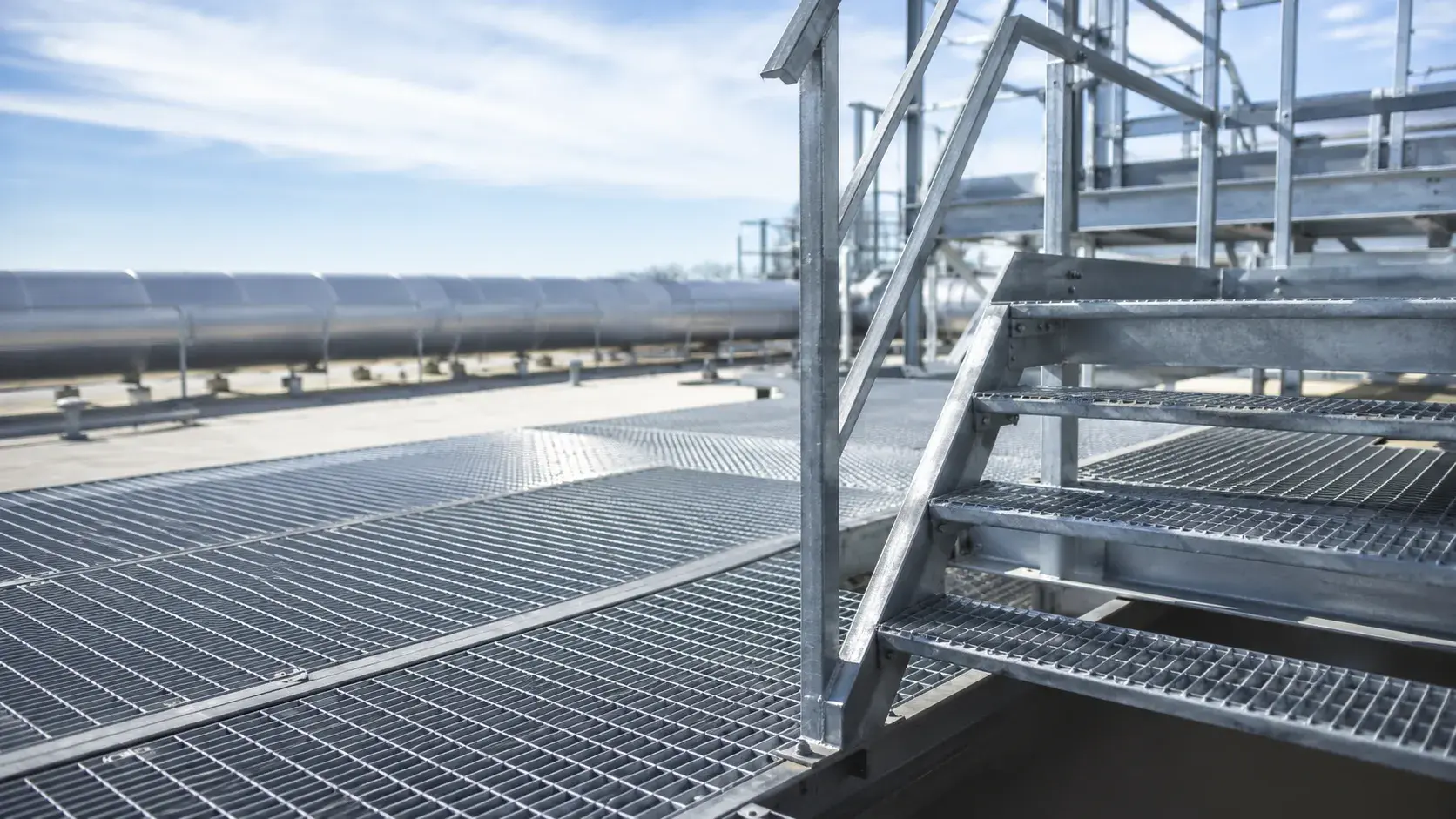
Heel-Proof and Barrier-Free Grate Openings: Getting Accessibility Right
How to spec heel-proof, bicycle-safe, and barrier-free grate openings that meet Ontario accessibility expectations, aperture limits, bar direction, and safe drainage on accessible routes.
On any accessible route in Ontario, a grate opening has to be small enough and oriented the right way so it cannot catch a heel, a cane tip, a wheelchair caster, or a bicycle tire. The practical rule fabricators work to is a narrow clear opening, run the bearing bars perpendicular to the main direction of travel, and keep the grate flush and stable in its frame. Get those three things right and the grate is barrier-free. Get any one wrong and you have built a trip hazard into a walking surface, which is exactly the outcome the Ontario Building Code and the AODA Design of Public Spaces Standard are written to prevent.
This guide explains what "barrier-free" really means for a grate, the aperture and bar-direction rules that matter most, how accessibility interacts with drainage, and the mistakes that turn a compliant-looking grate into an inspection problem. It is written for the architects, engineers, and contractors who own the detail where a grate lands on an accessible path.
What "Barrier-Free" Means for a Grate
A grate becomes an accessibility question the moment it sits in a walking surface that people use to get somewhere: an entrance approach, a sidewalk, a plaza, a courtyard, a transit platform, a loading area with pedestrian traffic, or any exterior path of travel. Two sets of expectations govern that surface in Ontario.
The first is the barrier-free provisions of the Ontario Building Code, which apply to the accessible paths inside and around a building. The second is the AODA Design of Public Spaces Standard, which covers exterior paths of travel and other public spaces. Both come at the same problem from the same direction: openings in a walking surface should not trap the things people move on or with. Your design authority confirms which requirements apply and the exact numbers for your project, but the fabrication intent is constant, and it is what the rest of this guide covers.
The takeaway is simple. A grate on an accessible route is not just a drainage part or a load-bearing part. It is a walking surface, and it has to behave like one under a heel, a wheel, and a mobility device.
The Aperture Rule That Matters Most
Aperture is the clear opening between bars, the actual gap a heel or tire can drop into. It is the single most important accessibility dimension on a grate, and it is the one most often confused with bar spacing. Spacing is centre-to-centre; aperture is the clear gap that remains after the bar thickness is subtracted. The safety dimension is always the clear opening, not the spacing.
Keep the Clear Opening Narrow
For gratings in a barrier-free walking surface, the working target is a small clear opening in the direction of travel, on the order of 13 mm (about half an inch) or less. That is tight enough to keep a standard heel, a cane or crutch tip, and a caster wheel riding on top of the bars rather than dropping between them. On exterior public paths, the AODA standard is framed around not allowing a small sphere to pass through the surface and orienting elongated openings correctly. Different wording, same goal: no gap large enough to swallow the thing a person is walking on.
Direction of Travel Is Half the Rule
A narrow opening only protects people if it is narrow in the direction they are walking. An elongated slot that runs the same way people travel becomes a channel that a heel or tire can slide into and jam. The same slot turned ninety degrees, so the long dimension crosses the path, lets the heel or wheel roll straight over it. This is why direction of travel is inseparable from the aperture number. You have to state both.
Bicycle-Safe Openings
Anywhere a grate sits in a surface cyclists use, a shared path, a bike lane crossing, or a plaza edge, the openings have to be bicycle-safe. A slot wide enough and aligned with travel can catch a tire and throw a rider. The fix is the same discipline as heel-proofing: keep the clear opening narrow, and run the bars across the direction of travel so a tire cannot drop in and track along a slot. When we detail grates for streetscapes we treat heel-proof and bicycle-safe as one combined requirement, because the geometry that solves one usually solves the other.
Bar Direction and Orientation
Because direction of travel drives so much, bar orientation is a real design decision, not a shop default. The bearing bars, the load-carrying members, should generally run perpendicular to the dominant path of travel on an accessible route, so the many small openings a foot encounters are the narrow ones.
This can pull against structural preference. Bearing bars are most efficient spanning the short way across a trench or frame, and that short span does not always line up with where people walk. When the efficient structural direction and the safe pedestrian direction disagree, accessibility on a walking surface wins, and the grate is engineered to carry the load in the orientation that keeps people safe. A grate that is structurally elegant but catches heels has failed at its actual job. Our guide on how to specify custom metal grates covers how to state span, load, and bar direction together so these do not collide late in the drawing.
Flush, Level, and Stable: The Trip Hazards Beyond the Slot
Aperture gets the attention, but three physical conditions cause just as many accessible-route problems, and all of them are fabrication and installation details.
- Flush with the surrounding surface. A grate or its frame that stands proud of the adjacent concrete, or sits below it, creates a lip. A raised or recessed edge on a walking path is a trip hazard and a catch point for a caster or cane. The grate top and the finished surface should meet at the same level, which makes the frame detail and the finished-floor coordination critical.
- No rock, no rattle. A grate that moves under a foot or wheel is both a hazard and a maintenance headache. Proper seating, correct panel weight for the frame, and secure anchorage keep it stable. See our note on measuring for a replacement grate that fits for how frame and seat dimensions control this.
- Secure but serviceable. On an accessible route the grate still has to be lockable or clipped so it cannot be displaced, yet removable for cleaning the drain below. Anti-displacement fasteners solve both at once.
Slip Resistance on Accessible Routes
Accessibility and slip resistance travel together. A barrier-free surface that turns slick when wet or icy is not usable, and Ontario weather guarantees both. On sloped approaches, entrance mats-of-steel, and any exterior path, the bar surface should provide traction, either through a serrated bearing bar profile or an applied grip finish. The detail is straightforward, but it has to be specified, not assumed. Our overview of anti-slip grating and the deeper serrated grating and traction guide cover where each approach fits. The point for accessibility is that a narrow, heel-proof opening and a slip-resistant top surface are two separate requirements, and an accessible-route grate needs both.
Where Accessibility Meets Drainage
Here is the tension that makes accessible grates genuinely custom work: accessibility wants the openings small, and drainage wants them open. Narrow the aperture for heel and tire safety and you reduce open area, which is the very thing that lets water through. Push open area up for flow and you risk an opening a heel can find.
You resolve it by geometry rather than by compromise. More bars with narrower, well-oriented slots can deliver enough open area for the flow while keeping every individual opening heel-proof and bicycle-safe. Sometimes the answer is a slightly larger grate footprint so the total open area lands where it needs to be without widening any single slot. This is exactly the balance our drainage grate sizing guide works through, and it is why a catalogue grate rarely satisfies both an accessibility requirement and a flow requirement at the same time. When a trench drain grate or a catch basin grate lands on a pedestrian route, the two requirements have to be solved as one problem.
Streetscape and plaza work adds a third layer, appearance, on top of accessibility and drainage. Architectural tree grates in a public square have to be heel-proof, bicycle-safe, and visually intentional all at once, which is squarely custom fabrication territory rather than a stock selection.
Common Accessibility Mistakes
- Specifying spacing, not aperture. Centre-to-centre spacing does not tell anyone the clear opening. State the clear gap, because that is the dimension a heel or tire actually meets.
- Ignoring direction of travel. A correct aperture aligned the wrong way is still a trap. Always pair the opening dimension with the bar direction relative to the path.
- Letting structure override the walking surface. Running bars the efficient structural way when it points the wrong way for pedestrians builds a heel-catcher. Engineer the load around the safe orientation instead.
- Forgetting the edge condition. A perfect grate set proud of the concrete, or below it, is a trip hazard at the frame. Flush and level is part of the accessibility requirement, not a finishing nicety.
- Treating slip resistance as optional. A heel-proof grate that is slick when wet still fails the person using the route. Specify traction on any exterior or sloped accessible surface.
- Assuming a stock grate is compliant. Catalogue open-area grates are often optimized for flow, not for heel or tire safety. Confirm the actual opening and orientation before you rely on it for an accessible path.
Frequently Asked Questions
What opening size makes a grate heel-proof on an accessible route?
The working target for a barrier-free walking surface is a narrow clear opening in the direction of travel, on the order of 13 mm (about half an inch) or less, which keeps a standard heel, cane tip, or caster riding on top of the bars. Your design authority confirms the exact figure for the applicable Ontario Building Code or AODA requirement, but tight, well-oriented openings are the intent in every case.
Which way should the bars run on a grate in a walkway?
The bearing bars should generally run perpendicular to the main direction people walk, so the narrow openings are the ones a foot or wheel crosses. An elongated slot aligned with travel can catch a heel or bicycle tire, while the same slot turned across the path lets it roll over safely. State bar direction relative to travel, not just the opening size.
Are heel-proof and bicycle-safe openings the same thing?
They are solved by the same geometry. A narrow clear opening run across the direction of travel keeps a heel from dropping in and keeps a bicycle tire from catching a slot and throwing the rider. When we detail grates for public routes we treat the two as one combined requirement rather than separate checks.
Can a grate be both heel-proof and drain enough water?
Yes, but usually only as a custom grate. Narrow openings reduce open area, so you recover the needed flow with more bars and well-oriented slots, or a slightly larger grate footprint, rather than by widening any single opening. Balancing accessibility against drainage is a core reason accessible-route grates are engineered to the site instead of pulled from a catalogue.
Have a grate landing on an accessible path, entrance, plaza, or streetscape? Send us the route, the loads, and the drainage you need, and we will detail a custom metal grate that is heel-proof, bicycle-safe, and built to the flow. Explore our drainage grates or get in touch to start. Back to The Grate Guys.
Get a quote for your project
Send sizes, quantities, and your deadline. We review it and reply with the next step.